Showing posts with label economy. Show all posts

Thursday, November 21, 2013

Social Security Generates Nearly $1.4 Trillion in Economic Activity


Social Security Generates Nearly $1.4 Trillion in Economic Activity, Supports More Than Nine Million Jobs

A new study from AARP’s Public Policy Institute calculates that each dollar paid to Social Security beneficiaries generates nearly two dollars in spending by individuals and businesses, adding about $1.4 trillion in total economic output to the U.S. economy in 2012. 

Social Security Generates Nearly $1.4 Trillion in Economic Activity

Friday, November 27, 2009

How Little We Know: The Challenges of Financial Reform


Good read.

To read this article --go here.

Subscribe to All American Investor via Email
Kindle: Amazon's 6" Wireless Reading Device


Original content Bob DeMarco, All American Investor

Friday, October 02, 2009

Jobless 27 Weeks or Longer Jumps to 5.4 Million


15.1 million Americans are now out of work. Or if you look at real unemployment-- 17 million.

One of the scariest statistics is the number of people unemployed 27 weeks or longer -- now 5.4 million. This number soared by 450,000 in the last month.

At 27 weeks, people start losing their unemployment benefits. Then what?

This number is likely to rise by another million plus by the end of the year?

This does not bode well for the economy or the the Christmas retail sales season.

Sources of Information

Real Unemployment Jumps to 17.0 Percent (Explanation)

Bureau of Labor Statistics -- Employment Situation news release

Table 12 in the Bureau of Labor Statistics

Commissioner's Statement on the Employment Situation


Follow E F Hutton on Twitter


Kindle: Amazon's 6" Wireless Reading Device

Wednesday, September 02, 2009

Institute for Supply Management Factory Index (ISM), (NAPM, Graph)


The Institute for Supply Management factory index (ISM)index rose to 52.9% in August, the first time the index has been above 50% since the early days of the recession in January 2008.


"The year-and-a-half decline in manufacturing output has come to an end, as 11 of 18 manufacturing industries are reporting growth when comparing August to July. While this is certainly a positive occurrence, we have to keep in mind that it is the beginning of a new cycle and that all industries are not yet participating in the growth. The August index of 52.9 percent is the highest since June 2007. The 4 percentage point increase was driven by significant strength in the New Orders Index, which is up 9.6 points to 64.9 percent, the highest since December 2004. The growth appears sustainable in the short term, as inventories have been reduced for 40 consecutive months and supply chains will have to re-stock to meet this new demand."
Subscribe to EF Hutton via Email

WHAT RESPONDENTS ARE SAYING ...
  • "Production is picking up as demand [for] orders is being accelerated." (Nonmetallic Mineral Products)
  • "Demand from automotive manufacturers increasing thanks to 'Cash for Clunkers.'" (Fabricated Metal Products)
  • "In addition to improved business come the complications of a supply chain drained of inventory." (Paper Products)
  • "The sudden increase in customer demand, plus the low inventories held at services centers, is causing a shortage in the supply of raw steel." (Transportation Equipment)
  • "[It] appears customers' inventories are getting low, and they are cautiously placing orders." (Apparel, Leather & Allied Products)
PMI

Manufacturing's 18 consecutive months of decline ended in August as the PMI registered 52.9 percent, which is 4 percentage points higher than the 48.9 percent reported in July. This is the highest reading since June 2007, when the index also registered 52.9 percent. A reading above 50 percent indicates that the manufacturing economy is generally expanding; below 50 percent indicates that it is generally contracting.

A PMI in excess of 41.2 percent, over a period of time, generally indicates an expansion of the overall economy. Therefore, the PMI indicates growth for the fourth consecutive month in the overall economy, as well as expansion in the manufacturing sector for the first time since January 2008. Ore stated, "The past relationship between the PMI and the overall economy indicates that the average PMI for January through August (42.2 percent) corresponds to a 0.3 percent increase in real gross domestic product (GDP). However, if the PMI for August (52.9 percent) is annualized, it corresponds to a 3.7 percent increase in real GDP annually."

Bob DeMarco is a citizen journalist and twenty year Wall Street veteran. Bob has written more than 700 articles with more than 18,000 links to his work on the Internet. Content from All American Investor has been syndicated on Reuters, the Wall Street Journal, Fox News, Pluck, Blog Critics, and a growing list of newspaper websites. Bob is actively seeking syndication and writing assignments.
Kindle: Amazon's 6" Wireless Reading Device

Tuesday, August 04, 2009

National Association of Purchasing Managers Report (Graph)


Economic activity in the manufacturing sector failed to grow in July for the 18th consecutive month, while the overall economy grew for the third consecutive month, say the nation's supply executives in the latest Manufacturing ISM Report On Business®.


The current index is 48.9 versus 44.8 in June. An increase of 4.1 percent.

A PMI reading above 50 percent indicates that the manufacturing economy is generally expanding; below 50 percent that it is generally declining. Institute for Supply Management
Subscribe to EF Hutton via Email

Follow E F Hutton on Twitter

Kindle: Amazon's 6" Wireless Reading Device

Monday, July 20, 2009

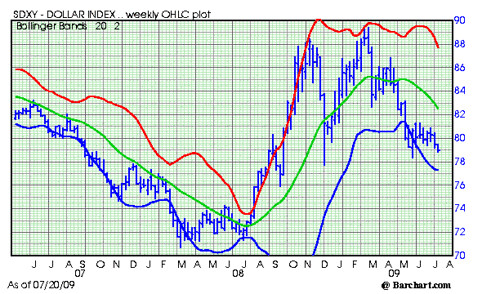
Dollar Index Approaching Near Term Support and Lows (Chart)


Subscribe to EF Hutton via Email

The Dollar Index (DI) is approaching its near term low of 78.34 made back in June, and 77.68 in December.

Back in March, a breakdown in the DI signaled a big break in the stock market. Will history repeat itself?

THE DI is a somewhat oversold here, so it should hold in short term.

This area and the resulting trade should be watched closely by investors.

The DI traded down to 70.69 in March.

Dollar Index Weekly Chart

Dollar Index Weekly Chart 720


Kindle: Amazon's 6" Wireless Reading Device

Saturday, July 18, 2009

M2, Money Supply Showing Signs of a Peak (Graph)


Subscribe to EF Hutton via Email

M2


Bob DeMarco is a citizen journalist and twenty year Wall Street veteran. Bob has written more than 700 articles with more than 18,000 links to his work on the Internet. Content from All American Investor has been syndicated on Reuters, the Wall Street Journal, Fox News, Pluck, Blog Critics, and a growing list of newspaper websites. Bob is actively seeking syndication and writing assignments.


Kindle: Amazon's 6" Wireless Reading Device

Friday, July 17, 2009

STATEMENT ON U.S. ECONOMIC OUTLOOK BY DR. NOURIEL ROUBINI


The following is a statement from Dr. Nouriel Roubini, Chairman of RGE Monitor and Professor, New York University, Stern School of Business:
“It has been widely reported today that I have stated that the recession will be over “this year” and that I have “improved” my economic outlook. Despite those reports - however – my views expressed today are no different than the views I have expressed previously. If anything my views were taken out of context.
Subscribe to EF Hutton via Email


STATEMENT ON U.S. ECONOMIC OUTLOOK BY DR. NOURIEL ROUBINI

“I have said on numerous occasions that the recession would last roughly 24 months. Therefore, we are 19 months into that recession. If as I predicted the recession is over by year end, it will have lasted 24 months with a recovery only beginning in 2010. Simply put I am not forecasting economic growth before year’s end.

“Indeed, last year I argued that this will be a long and deep and protracted U-shaped recession that would last 24 months. Meanwhile, the consensus argued that this would be a short and shallow V-shaped 8 months long recession (like those in 1990-91 and 2001). That debate is over today as we are in the 19th month of a severe recession; so the V is out of the window and we are in a deep U-shaped recession. If that recession were to be over by year end – as I have consistently predicted – it would have lasted 24 months and thus been three times longer than the previous two and five times deeper – in terms of cumulative GDP contraction – than the previous two. So, there is nothing new in my remarks today about the recession being over at the end of this year.

“I have also consistently argued – including in my remarks today - that while the consensus predicts that the US economy will go back close to potential growth by next year, I see instead a shallow, below-par and below-trend recovery where growth will average about 1% in the next couple of years when potential is probably closer to 2.75%.

“I have also consistently argued that there is a risk of a double-dip W-shaped recession toward the end of 2010, as a tough policy dilemma will emerge next year: on one side, early exit from monetary and fiscal easing would tip the economy into a new recession as the recovery is anemic and deflationary pressures are dominant. On the other side, maintaining large budget deficits and continued monetization of such deficits would eventually increase long term interest rates (because of concerns about medium term fiscal sustainability and because of an increase in expected inflation) and thus would lead to a crowding out of private demand.

“While the recession will be over by the end of the year the recovery will be weak given the debt overhang in the household sector, the financial system and the corporate sector; and now there is also a massive re-leveraging of the public sector with unsustainable fiscal deficits and public debt accumulation.

“Also, as I fleshed out in detail in recent remarks the labor market is still very weak: I predict a peak unemployment rate of close to 11% in 2010. Such large unemployment rate will have negative effects on labor income and consumption growth; will postpone the bottoming out of the housing sector; will lead to larger defaults and losses on bank loans (residential and commercial mortgages, credit cards, auto loans, leveraged loans); will increase the size of the budget deficit (even before any additional stimulus is implemented); and will increase protectionist pressures.

“So, yes there is light at the end of the tunnel for the US and the global economy; but as I have consistently argued the recession will continue through the end of the year, and the recovery will be weak and at risk of a double dip, as the challenge of getting right the timing and size of the exit strategy for monetary and fiscal policy easing will be daunting.

“RGE Monitor will soon release our updated U.S. and Global Economic Outlook. A preview of the U.S. Outlook is available on our website: www.rgemonitor.com”


Bob DeMarco is a citizen journalist and twenty year Wall Street veteran. Bob has written more than 700 articles with more than 18,000 links to his work on the Internet. Content from All American Investor has been syndicated on Reuters, the Wall Street Journal, Fox News, Pluck, Blog Critics, and a growing list of newspaper websites. Bob is actively seeking syndication and writing assignments.


Kindle: Amazon's 6" Wireless Reading Device

Wednesday, July 08, 2009

Roubini Still Has Lingering Concerns About the Economy


In conclusion, the outlook for the U.S. economy remains very weak. The recent rally in global equities, commodities and credit may soon fizzle out as worse-than-expected earnings and financial news take their toll on this rally, which has gotten ahead of improvements in actual macroeconomic data.

Source: RGE Monitor Newsletter
Subscribe to EF Hutton via Email


Lingering Concerns:

Labor market conditions are still quite dire, more than 3.4 million jobs have been lost in 2009 and about 6.5 million have been lost since the beginning of the recession. Compare this with the 2.5 million jobs lost in the recession of 2001; 1.5 million lost in the recession of the early 1990s; 3 million in the one of the early 1980s; 2.2 million in the one of the 1970s.

The pace of job losses has fallen from the 600K plus per month registered between December and March 2009 to about 350K in May and 467K in June; the average monthly job losses in this recession is now at about 360K. While the recent slowing of losses is a positive development, we have to put this in perspective: in previous post-war recessions, average monthly job losses have ranged between 150 thousand and 260 thousand. Moreover, average weekly hours in private nonfarm payrolls are at the lowest since 1964, as employers have cut employees’ hours. Job openings and turnover openings continue to fall and are at the lowest levels since 2000, indicating continued weakness in the economy.

The U.S. consumer is still the engine of U.S. growth, and contributes to over 70% of aggregate demand. While saving rates are headed for the high single digits and high oil prices together with long-term rates keep putting a dent in personal consumption, the over-leveraged consumer is finding some support in the tax breaks of the fiscal stimulus package. Yet the over-indebted U.S. consumer – whose deleveraging process yet has to start – will likely continue to put the brakes on consumption, while the savings rate continues to creep up. While this will encourage a rebalancing in the U.S. and global economy, in the medium-term it isn’t likely to support strong U.S. and global growth.

Housing starts appear to have stabilized and will likely move sideways for quite some time. However, housing demand is not yet improving at a pace that can guarantee that the lingering inventory overhang will dissipate. This implies that home prices will continue to fall. RGE Monitor expects home prices to continue to fall through mid-2010.

U.S. industrial production has been contracting for 17 months in a row – with a short break in October 2008. Industrial production usually finds a bottom shortly after the ISM manufacturing index does. While the index probably found its bottom back in December 2008--at depression levels of 32.9--industrial production remains in a mode of contraction that started in January 2008.

Financial conditions are showing some improvement. Banks are borrowing at zero interest rates and higher net interest margin can definitely help rebuild capital. Regulatory forbearance, changes in FASB (Financial Accounting Standards Board) rules and under-provisioning might enable banks to post better than expected results for a few quarters. However, relaxation of mark-to-market rules reduces the banks’ incentives to participate in the Public-Private Investment Program (PPIP) and therefore reduces the likelihood that the program will succeed in clearing toxic assets from banks’ balance sheets. The muddle-through approach might be successful in a scenario in which the U.S. and global economy recover soon and go back to potential growth during 2010, but according to RGE’s forecasts, this is highly unlikely. While we might have positive surprises coming from the banking system in the next couple of quarters, the situation could turn around again after that, jarring confidence in financial markets in a way that would spill into the real economy. Increases in the unemployment rate, well beyond the rates envisioned by the adverse scenario of the recent bank stress tests, imply that recapitalization needs are larger than what the too-lenient stress test prescribed. The U.S financial system – in spite of the massive policy backstop – thus remains severely damaged, and the credit crunch remains unlikely to ease very fast.

A sharp rise in public debt burden – the U.S. Congressional Budget Office estimates that the public-debt-to-GDP ratio will rise from 40% to 80% (in the next decade), or about $9 trillion – will also put a dent on growth. If long-term rates were to increase to 5%, the resulting increase in the interest rate bill alone would be about $450 billion, or 3% of GDP. The implication is that the fiscal primary surplus will have to be permanently increased by 3% of GDP, which could constitute further pressure on the disposable income of the U.S. consumer.

Not only does the U.S. economy face downward risks to growth in the medium-term, but potential growth might fall as well. The U.S. population is aging. With employment still falling – and another jobless recovery on the horizon – the rate of human capital accumulation will fall. Moreover, workers who remain unemployed for a long period of time lose skills, while young workers that enter the workforce, but don’t find a job, don’t acquire on-the-job skills. Reduced investments in worker training and education, coupled with lower capital expenditure, are a recipe for lower productivity ahead.

Deflationary pressures are still present in the U.S. economy. Demand is falling relative to supply and excess capacity is still promoting slack in the goods markets. Moreover, the rising slack in labor markets, which is pushing down wages and labor costs, implies that deflationary pressures are going to be dominant this year and next year. This implies that the Fed will keep monetary policy loose for a while longer. However, discussion of an exit strategy has to start now as investors’ concerns about the Fed’s ballooning balance sheet and expectations of inflation both mount.

There are also signs that a double-dip recession could materialize toward the second half of next year, or in 2011. If oil prices rise too much, too fast, too soon, that’s going to have a negative effect in terms of trade and real disposable income in oil-importing countries. Also, concerns about unsustainable budget deficits are high and are pushing long-term interest rates higher. If these budget deficits are going to continue to be monetized, eventually, toward the end of next year, there is a risk of a sharp increase in expected inflation that could push interest rates even higher. Together with higher oil prices, driven up in part by this wall of liquidity rather than fundamentals alone, this could be a double whammy that would push the economy into a double-dip or W-shaped recession by late 2010 or 2011.

In conclusion, the outlook for the U.S. economy remains very weak. The recent rally in global equities, commodities and credit may soon fizzle out as worse-than-expected earnings and financial news take their toll on this rally, which has gotten ahead of improvements in actual macroeconomic data.


Bob DeMarco is a citizen journalist and twenty year Wall Street veteran. Bob has written more than 700 articles with more than 18,000 links to his work on the Internet. Content from All American Investor has been syndicated on Reuters, the Wall Street Journal, Fox News, Pluck, Blog Critics, and a growing list of newspaper websites. Bob is actively seeking syndication and writing assignments.


Original content All American Investor

More from All American Investor

Kindle: Amazon's 6" Wireless Reading Device

Tuesday, June 16, 2009

Industrial Production Index Drops Hard (Graph)


G.17 Industrial Production and Capacity Utilization
Subscribe to EF Hutton via Email
Bob DeMarco is a citizen journalist and twenty year Wall Street veteran. Bob has written more than 500 articles with more than 11,000 links to his work on the Internet. Content from All American Investor has been syndicated on Reuters, the Wall Street Journal, Fox News, Pluck, Blog Critics, and a growing list of newspaper websites. Bob is actively seeking syndication and writing assignments.


Kindle: Amazon's 6" Wireless Reading Device

Friday, June 12, 2009

Monetary Base Continues to Soar (Graph)


Monetary Base Continues to Soar
Subscribe to All American Investor via Email

This chart helps explain why investors are increasingly worried about future inflation. The adjusted monetary base has nearly doubled since April, 2008. In comparison, the moneatry base doubled once from January, 1994 to October, 2005.

Bob DeMarco is a citizen journalist and twenty year Wall Street veteran. Bob has written more than 500 articles with more than 11,000 links to his work on the Internet. Content from All American Investor has been syndicated on Reuters, the Wall Street Journal, Fox News, Pluck, Blog Critics, and a growing list of newspaper websites. Bob is actively seeking syndication and writing assignments.


More from All American Investor

Kindle: Amazon's 6" Wireless Reading Device


Follow All American Investor on Twitter

Thursday, June 11, 2009

6,816,000 Americans on the Dole


Sometime you have to look beyond the obvious. Continuing claims for unemployment set a record for the 19th consecudtive week. Nearly 6.82 million American are now receiving unemployment checks weekly. What happens when the benefits run out?

UNEMPLOYMENT INSURANCE WEEKLY CLAIMS REPORT

In the week ending June 6, the advance figure for seasonally adjusted initial claims was 601,000, a decrease of 24,000 from the previous week's revised figure of 625,000. The 4-week moving average was 621,750, a decrease of 10,500 from the previous week's revised average of 632,250.

The advance seasonally adjusted insured unemployment rate was 5.1 percent for the week ending May 30, unchanged from the prior week's revised rate of 5.1 percent.

The advance number for seasonally adjusted insured unemployment during the week ending May 30 was 6,816,000, an increase of 59,000 from the preceding week's revised level of 6,757,000. The 4-week moving average was 6,750,500, an increase of 57,250 from the preceding week's revised average of 6,693,250.

The fiscal year-to-date average for seasonally adjusted insured unemployment for all programs is 5.238 million.

Source Department of Labor
Subscribe to EF Hutton via Email


Bob DeMarco is a citizen journalist and twenty year Wall Street veteran. Bob has written more than 500 articles with more than 11,000 links to his work on the Internet. Content from All American Investor has been syndicated on Reuters, the Wall Street Journal, Fox News, Pluck, Blog Critics, and a growing list of newspaper websites. Bob is actively seeking syndication and writing assignments.


Follow E F Hutton on Twitter

Kindle: Amazon's 6" Wireless Reading Device

Tuesday, June 09, 2009

The Housing and Credit Crisis Explained


This presentation on the Housing and Credit crisis is the best I have seen. It explains everything from soup to nuts.

Each slide contains a graph that is well explained.

They say a picture is worth a thousand words.

Once you get through this, you will understanding the current credit crisis in housing, and what to expect in the years ahead.

If you take the time to view and read this you will be fully informed.

Hit the full screen button in the upper right hand corner of the panel below.

T2 Partners Presentation on the Mortgage Crisis

Subscribe to All American Investor via Email


Bob DeMarco is a citizen journalist and twenty year Wall Street veteran. Bob has written more than 500 articles with more than 11,000 links to his work on the Internet. Content from All American Investor has been syndicated on Reuters, the Wall Street Journal, Fox News, Pluck, Blog Critics, and a growing list of newspaper websites. Bob is actively seeking syndication and writing assignments.


More from All American Investor

Kindle: Amazon's 6" Wireless Reading Device

Friday, April 24, 2009

Roubini: Economist Forecast on Economy Optimistic


Mild signs that the rate of economic contraction is slowing in the United States, China and other parts of the world have led many economists to forecast that positive growth will return to the US in the second half of the year, and that a similar recovery will occur in other advanced economies.

The emerging consensus among economists is that growth next year will be close to the trend rate of 2.5 per cent.
This consensus optimism is, I believe, not supported by the facts. Indeed, I expect that while the rate of US contraction will slow from -6 per cent in the last two quarters, US growth will still be negative (around -1.5 to -2 per cent) in the second half of the year (compared to the bullish consensus of +2 per cent).


Subscribe to All American Investor via Email

End of Economic Gloom? Not as Early as You Wish. Roubini’s latest Article for Project Syndicate

End of economic gloom? Nouriel Roubini

Mild signs that the rate of economic contraction is slowing in the United States, China and other parts of the world have led many economists to forecast that positive growth will return to the US in the second half of the year, and that a similar recovery will occur in other advanced economies.

The emerging consensus among economists is that growth next year will be close to the trend rate of 2.5 per cent.

Investors are talking of 'green shoots' of recovery and of positive 'second derivatives of economic activity' (continuing economic contraction is the first, negative, derivative, but the slower rate suggests that the bottom is near).

As a result, stock markets have started to rally in the US and around the world. Markets seem to believe that there is light at the end of the tunnel for the economy and for the battered profits of corporations and financial firms.

This consensus optimism is, I believe, not supported by the facts. Indeed, I expect that while the rate of US contraction will slow from -6 per cent in the last two quarters, US growth will still be negative (around -1.5 to -2 per cent) in the second half of the year (compared to the bullish consensus of +2 per cent).

Moreover, growth next year will be so weak (0.5 to 1 per cent, as opposed to the consensus of 2 per cent or more) and unemployment so high (above 10 per cent) that it will still feel like a recession.

In the euro zone and Japan, the outlook for 2009 and 2010 is even worse, with growth close to zero even next year. China will have a more rapid recovery later this year, but growth will reach only 5 per cent this year and 7 per cent in 2010, well below the average of 10 per cent over the last decade.

Given this weak outlook for the major economies, losses by banks and other financial institutions will continue to grow. My latest estimates are $3.6 trillion in losses for loans and securities issued by US institutions, and $1 trillion for the rest of the world.

It is said that the International Monetary Fund, which earlier this year revised upward its estimate of bank losses, from $1 trillion to $2.2 trillion, will announce a new estimate of $3.1 trillion for US assets and $0.9 trillion for foreign assets, figures very close to my own.

By this standard, many US and foreign banks are effectively insolvent and will have to be taken over by governments. The credit crunch will last much longer if we keep zombie banks alive despite their massive and continuing losses.

Given this outlook for the real economy and financial institutions, the latest rally in US and global stock markets has to be interpreted as a bear-market rally. Economists usually joke that the stock market has predicted 12 out of the last nine recessions, as markets often fall sharply without an ensuing recession.

But, in the last two years, the stock market has predicted six out of the last zero economic recoveries -- that is, six bear market rallies that eventually fizzled and led to new lows.

The stock market's latest 'dead cat bounce' may last a while longer, but three factors will, in due course, lead it to turn south again. First, macroeconomic indicators will be worse than expected, with growth failing to recover as fast as the consensus expects.

Second, the profits and earnings of corporations and financial institutions will not rebound as fast as the consensus predicts, as weak economic growth, deflationary pressures and surging defaults on corporate bonds will limit firms' pricing power and keep profit margins low.

Third, financial shocks will be worse than expected.

At some point, investors will realise that bank losses are massive, and that some banks are insolvent. Deleveraging by highly leveraged firms -- such as hedge funds -- will lead them to sell illiquid assets in illiquid markets. And some emerging market economies -- despite massive IMF support -- will experience a severe financial crisis with contagious effects on other economies.

So, while this latest bear-market rally may continue for a bit longer, renewed downward pressure on stocks and other risky assets is inevitable.

To be sure, much more aggressive policy action (massive and unconventional monetary easing, larger fiscal-stimulus packages, bailouts of financial firms, individual mortgage-debt relief, and increased financial support for troubled emerging markets) in many countries in the last few months has reduced the risk of a near depression. That outcome seemed highly likely six months ago, when global financial markets nearly collapsed.

Still, this global recession will continue for a longer period than the consensus suggests. There may be light at the end of the tunnel -- no depression and financial meltdown. But economic recovery everywhere will be weaker and will take longer than expected. The same is true for a sustained recovery of financial markets.

Nouriel Roubini is professor of economics at the Stern School of Business, New York University, and chairman of RGE Monitor. Copyright: Project Syndicate, 2009.

Access to some RGE EconoMonitors, including Nouriel Roubini's Global EconoMonitor, is reserved for registered users, so sign up now to read and comment on current postings. These writings are only a small part of the insights and commentary available through RGE Monitor. Contact us today at info@rgemonitor.com or 212.645.0010 to learn more about becoming a full subscriber.
Go Check it Out.

Bob DeMarco is a citizen journalist and twenty year Wall Street veteran. Bob has written more than 500 articles with more than 11,000 links to his work on the Internet. Content from All American Investor has been syndicated on Reuters, the Wall Street Journal, Fox News, Pluck, Blog Critics, and a growing list of newspaper websites. Bob is actively seeking syndication and writing assignments.


More from All American Investor


Follow All American Investor on Twitter

Thursday, April 02, 2009

S & P 500 Trend Up, Shorts Vunerable


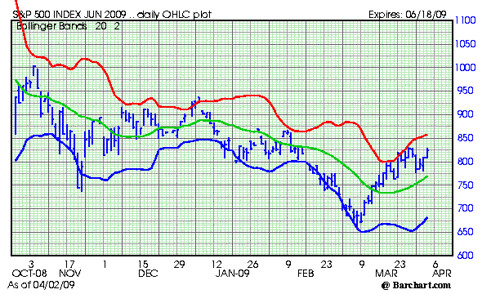
June S and P Future, Chart

JUNE SP 4021

Notes:
  • The market held the down thrust below 790. The reversal indicates the uptrend is intact.
  • Yesterday's outside, up day, with a close at the high indicated that a test of the resistance in the 830 area was likely.
  • The ability of the market to hold above the green line is important and impressive.
  • Short term support is at 770 and rising.
  • Near term resistance is in the 830 area. Overhead resistance is at 857 and rising.
  • Trades and or a close above 832 will test the will of the shorts.
  • The market continues to trade up against bad news. Shorts continue to pile into the market believing that the market should be going down against this evidence.
  • All I can say to shorts is---Don't Fight the Tape.
  • Technical evidence continues to indicate higher prices.
See:

They called me crazy, S and P 900-1000


Bob DeMarco is a citizen journalist and twenty year Wall Street veteran. Bob has written more than 500 articles with more than 11,000 links to his work on the Internet. Content from All American Investor has been syndicated on Reuters, the Wall Street Journal, Fox News, Pluck, Blog Critics, and a growing list of newspaper websites. Bob is actively seeking syndication and writing assignments.


Follow E F Hutton on Twitter
Subscribe to EF Hutton via Email

Monday, March 23, 2009

Geithner Speaks: My Plan for Bad Bank Assets


No crisis like this has a simple or single cause, but as a nation we borrowed too much and let our financial system take on irresponsible levels of risk.
Geithner
However, the financial system as a whole is still working against recovery. Many banks, still burdened by bad lending decisions, are holding back on providing credit. Market prices for many assets held by financial institutions -- so-called legacy assets -- are either uncertain or depressed. With these pressures at work on bank balance sheets, credit remains a scarce commodity, and credit that is available carries a high cost for borrowers.
Our new Public-Private Investment Program will set up funds to provide a market for the legacy loans and securities that currently burden the financial system.
The funds established under this program will have three essential design features.
  • First, they will use government resources in the form of capital from the Treasury, and financing from the FDIC and Federal Reserve, to mobilize capital from private investors.
  • Second, the Public-Private Investment Program will ensure that private-sector participants share the risks alongside the taxpayer, and that the taxpayer shares in the profits from these investments.
  • Third, private-sector purchasers will establish the value of the loans and securities purchased under the program, which will protect the government from overpaying for these assets.
Our goal must be a stronger system that can provide the credit necessary for recovery, and that also ensures that we never find ourselves in this type of financial crisis again. We are moving quickly to achieve those goals, and we will keep at it until we have done so.
Read the entire Geithner statement.
Subscribe to EF Hutton via Email


Sunday, March 22, 2009

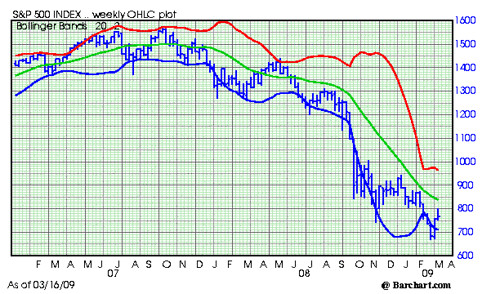
S and P 500 Weekly Chart


S an P 500 Weekly Chart March


On March 7, we posted the Monthly chart of the S and P 500 and pointed out the slope of the market was unsustainable and that a rally was likely. From that article,
You can see the slope of the market is very severe. This cannot be sustained much longer. When a market index trades down at a sharp angle like the one above (See March 7 chart), the market always rallies sharply when it reverses directions. This rally could start at any time.
Since then, we had two weeks up in the market as shown in the weekly chart above.

Now the question is what next? Technically this is a difficult question to answer. I would say this week is fifty-fifty. As you can see, the downtrend is still intact. The market is now above the blue line which indicates the severe oversold condition is not over. Overall, it is always more risky to be a buyer when the trend of the market is down--so it is still a time to be very cautious. I would also so, at this point the easy money has already been made on the downside. Toss up.

My best guess right now is that market is going to continue to consolidate and move sideways in the area between 663 and 800 before it makes its next move. On the fundamental side, I will be posting a new article entitled, Don't Fight the Tape, which makes an argument for additional upside in the market.
Subscribe to EF Hutton via Email
Bob DeMarco is a citizen journalist and twenty year Wall Street veteran. Bob has written more than 500 articles with more than 11,000 links to his work on the Internet. Content from All American Investor has been syndicated on Reuters, the Wall Street Journal, Fox News, Pluck, Blog Critics, and a growing list of newspaper websites. Bob is actively seeking syndication and writing assignments.

Wednesday, March 18, 2009

Trend World Protectionism on the Rise


I think most people believe that trade barriers are a bad thing. World protectionism and trade barriers prolonged the recession and impacted trade negatively in the 1930s.

I have to ask myself--have we really learned anything from the past? Or, are we doomed to repeat the same old mistakes?

Seventeen of the G-20 countries recently implemented 47 measures whose effect is to restrict trade at the expense of other countries. I can just hear the analyst on TV--this is no big deal and it won't have a big impact on trade.

These analyst, are the same analyst that, told us over and over that the housing bubble wouldn't have a big effect on the economy or stocks. Right Larry Kudlow? The same analyst that failed to see the interconnectedness of banks and financial companies--as Bear Stears, Lehman, and AIG went down the tube and brought other companies that did business with them to the brink of disaster.

For some reason, analyst have a problem seeing how things are interconnected. They are either dumb, myopic, or in a state of denial like most the country.

You hear the words global economy over and over. There can be no doubt that the world economy is now interconnected. It should be obvious that if one spoke in this interconnectedness breaks the entire wheel stops working. Think of it like the wheel on a bike--when the spoke breaks the wheels gets all wobbly. If you keep riding on the wheel, it will eventually weaken and then collapse. The lesson from this story is, if you fix the broken spoke immediately--the wheel works just fine. But if you keep riding on the bad wheel--it collapses.

There is at the minimum anecdotal evidence that global protectionism is on the rise. What are world leaders and politicians likely to do to satisfy angry constituents when their job is on the line? At first, they will stick a lollipop in the mouth of their constituents. But, if that doesn't work, they will give them what they want to perpetuate themselves in office. This is worrisome.

Over here in the U.S. we are now protecting steel, soon it will be the importation of foreign automobiles, then what? For every action there is likely to be an equal and opposite reaction. These are trends that investors need to be watching. Excessive protectionism could cause the next collapse in stock prices. As an investor you need to keep your eyes and ears open--you really need to pay attention to trends and how they can effect stock prices. Like it says up at the top:
How to make money in the market...think beyond the obvious...spot the trends...and do your homework.


If you would like to read about protectionism go here.
Subscribe to EF Hutton via Email

Tuesday, March 17, 2009

AIG Trick me once shame on you, trick me twice shame on me


Feel free to substitute the appropriate word for the word--trick--in the headline. Be creative.

You really have to ask yourself--are the nuts running the nut house?

How long before the taxpayers take to the mall in Washington, DC to show what we really think. We own the company. Isn't it time to replace the board and management?

I'll remind everyone. When we GAVE the first $85 billion to AIG it was with the understanding that it would be paid back within two years.

Trick me once shame on you, trick me twice shame on me.


Subscribe to EF Hutton via Email

Sunday, March 15, 2009

60 Minutes Ben Bernanke's Greatest Challenge (Video and Text)


60 Minutes features a rare interview with a Federal Reserve chairman - the first in 20 years - Bernanke tells correspondent Scott Pelley what he thinks went wrong with America's financial system, how it caused the economic crisis, what the Federal Reserve is doing to help fix it and when he expects the crippling recession to end.

In the interview, Bernanke also talks about the failure of Lehman Brothers, the rescue plan for AIG and the Fed’s extraordinary actions taken since the beginning of the economic crisis. The Fed Chairman also discusses how regulations might change in the future.


Subscribe to EF Hutton via Email


"Mr. Chairman, I'm gonna start with a question that everyone wants me to ask: when does this end?" 60 Minutes correspondent Scott Pelley asked Bernanke.

"It depends a lot on the financial system," he replied. "The lesson of history is that you do not get a sustained economic recovery as long as the financial system is in crisis. We've seen some progress in the financial markets, absolutely. But until we get that stabilized and working normally, we're not gonna see recovery. But we do have a plan. We're working on it. And I do think that we will get it stabilized, and we'll see the recession coming to an end probably this year. We'll see recovery beginning next year. And it will pick up steam over time."

Asked if he thinks the recession is going to end this year, Bernanke said, "In the sense that this decline will begin to moderate and we'll begin to see leveling off. We won't be back to full employment. But we will see, I hope, the end of these declines that have been so strong in a last couple of quarters."

"But you wouldn't say at this point that we're out of the woods?" Pelley asked.

"No," Bernanke replied. "I think the key issue is the banking system and the financial system."

"Unemployment, as we sit here, is about 8.1 percent. I wonder, do you expect double digit unemployment?" Pelley asked.

"Well, it's hard to forecast exactly where we're going. Unemployment is rising. Job losses are still very severe. And no doubt, the unemployment rate's gonna go higher than it is. But I think, again, that if we do succeed in stabilizing the financial system, that we'll begin to see a slower pace of decline, and eventually, a stabilization that will set the basis for a recovery," Bernanke said.

"You seem to be saying that we're not heading into a new American Depression?" Pelley asked.

"I think we've averted that risk. I think we've gotten past that and now the problem is to get the thing working properly again," the chairman said.

Bernanke, age 55, has been chairman of the Federal Reserve Board since 2006. He had previously served as a Fed governor, then chairman of the President's Council of Economic Advisers, before being appointed as Fed chairman by President George W. Bush.

For this interview, he opened up the Fed headquarters, rarely seen by the public. It's a monumental building along the National Mall. Construction started in 1935 in the depths of the Great Depression.

"You know Mr. Chairman I think the Federal Reserve, for most people, is a mystery," Pelley remarked.

"Well, it's an institution that people don't hear so much about but it's a very important one. It manages monetary policy for the country. It's one of the main tools we have for stabilizing our economy and keeping prices stable," Bernanke said.

Asked when it was founded, Bernanke told Pelley, "The Fed was created by Congress in 1913. And its original purpose was to deal with financial panics, which is what we're doing right now."

Bernanke's crisis started in 2007 with the mortgage meltdown; lenders began to fail. Bernanke cut interest rates repeatedly. In 2008, the Fed stopped the collapse of Bear Stearns by arranging a sale to another firm.

But then came the end of Wall Street as we knew it. Mortgage giants Fannie Mae and Freddie Mac were seized by the government. On Sept. 14, Merrill Lynch was sold in distress. The next day, the 158-year-old investment bank Lehman Brothers failed

"You didn't rescue Lehman Brothers. It set off a worldwide panic when it went bankrupt. And I wonder, looking back, whether you think that was a mistake," Pelley asked.

"There were many people who said, 'Let 'em fail.' You know, 'It's not a problem. The markets will take care of it.' And I think I knew better than that. And Lehman proved that you cannot let a large internationally active firm fail in the middle of a financial crisis. Now was it a mistake? It wasn't a mistake for the following reason: we didn't have the option, we didn't have the tools. All the Federal Reserve can do is make loans against collateral," Bernanke replied.

The day after Lehman, Bernanke's Fed did something astounding: it loaned $85 billion to a company that wasn't a bank at all - American International Group (AIG), the global insurance giant that was also involved in backing risky mortgage investments. Bernanke says, unlike Lehman, the Fed could make the loans based on good collateral in AIG's portfolio.

"There have now been four rescues of AIG, $160 billion. Why is that necessary?" Pelley asked.

"Let me just first say that of all the events and all of the things we've done in the last 18 months, the single one that makes me the angriest, that gives me the most angst, is the intervention with AIG. Here was a company that made all kinds of unconscionable bets. Then, when those bets went wrong, we had a situation where the failure of that company would have brought down the financial system," Bernanke said.

"You say it makes you angry?" Pelley asked.

"It makes me angry. I slammed the phone more than a few times on discussing AIG. I understand why the American people are angry. It's absolutely unfair that taxpayer dollars are going to prop up a company that made these terrible bets, that was operating out of the sight of regulators, but which we have no choice but the stabilize, or else risk enormous impact, not just in the financial system, but on the whole U.S. economy," Bernanke explained.

By September, Bernanke and then-Treasury Secretary Hank Paulson went to Capitol Hill to urge a massive bailout of the banking system, which lawmakers soon passed.

Asked how close of a call it was, Bernanke said, "It was very close. It was very close. The Congress passed the bill that gave Treasury the right to put capital into the banks in the first week of October. And it was in the second week of October that the crisis reached its peak. If we had not had those powers, we could have had a much, much worse outcome. So it was a very dangerous situation."

"Was anyone on Capitol Hill skeptical? Did they push back at all, you know, 'Mr. Chairman, it's probably not quite that bad'?" Pelley asked.

"Well, I do remember one conversation I had where I was addressing a caucus of congressmen. And a congressman said to me, 'Mr. Chairman, you know, I'm talking to bankers in my town. I'm talking to shopkeepers in my town. And they say things are normal. Nothing's going on. We don't see any problem.' And I turned to him and I said, 'You will,'" Bernanke recalled.

That second week of October, the Dow fell 18 percent - its worst week in history. At that point, $8 trillion had been lost.

In the crisis, Bernanke had freedom to act immediately - he doesn't need permission from Congress or the president. While they debated on Capitol Hill, Bernanke cut interest rates nearly to zero; then he used Depression-era emergency powers to launch a dozen rescue programs of his own. There was support for money market funds, mortgages, short term lending to small business, and support for auto loans, student loans and small business loans - commitments of a trillion dollars, doubling the size of the Fed's balance sheet.

Asked if it's tax money the Fed is spending, Bernanke said, "It's not tax money. The banks have accounts with the Fed, much the same way that you have an account in a commercial bank. So, to lend to a bank, we simply use the computer to mark up the size of the account that they have with the Fed. It's much more akin to printing money than it is to borrowing."

"You've been printing money?" Pelley asked.

"Well, effectively," Bernanke said. "And we need to do that, because our economy is very weak and inflation is very low. When the economy begins to recover, that will be the time that we need to unwind those programs, raise interest rates, reduce the money supply, and make sure that we have a recovery that does not involve inflation."

He's not kidding about printing money: the Fed issues U.S. currency, which is why it says "Federal Reserve Note" on all the bills in your wallet. The Treasury Department's Bureau of Engraving and Printing is just a few blocks from Bernanke's office. It prints the money at the Fed's request.

The Fed's mandate from Congress is to put enough money i the system for maximum employment, but not so much that it sets off inflation.

The Fed actually pays for itself and returns billions in profits to the Treasury.

In a sense, Bernanke has been preparing for this emergency his whole professional life. He got a PhD in economics from MIT. He chaired the economics department at Princeton, where his specialty was the Great Depression.

He's among many economists who now believe it was the Federal Reserve itself that helped turn a recession in 1929 into a global calamity.

"They made two mistakes, basically. One was they let the money supply contract very sharply. Prices fell. Deflation. So monetary policy was, in fact, very contractionary. Very tight during that period. And then the second mistake they made was they let the banks fail. They didn't make any strong effort to prevent the failure of thousands of banks. And that failure had terrible effects on credit and on the ability of the economy to right itself," Bernanke explained.

Bernanke told 60 Minutes we were close to a second Depression and he is determined to not let the major banks fail on his watch.

"One of the things that I think many people watching this interview don't understand, is why there are multiple bailouts, four bailouts of AIG, three bailouts of Citigroup. There is a sense that this is a band-aid approach, that we're not getting to the root of the problem," Pelley remarked.

"Well, part of the issue is that, you know, the economy has gotten a good bit worse. You know, the first part of the crisis was subprime and other assets that were toxic. Now, we're in a second phase, which is that the economy is very weak," he said. "So the economy's weakness has meant that some of the initial attempts to stabilize the banks haven't been enough, and we've had to do more."

"You know, Mr. Chairman, there are so many people outside this building, across this country, who say, 'To hell with them. They made bad bets. The wages of failure on Wall Street should be failure,'" Pelley remarked.

"Let me give you an analogy, if I might," Bernanke said. "If you have a neighbor, who smokes in bed. And he's a risk to everybody. If suppose he sets fire to his house, and you might say to yourself, you know, 'I'm not gonna call the fire department. Let his house burn down. It's fine with me.' But then, of course, but what if your house is made of wood? And it's right next door to his house? What if the whole town is made of wood? Well, I think we'd all agree that the right thing to do is put out that fire first, and then say, 'What punishment is appropriate? How should we change the fire code? What needs to be done to make sure this doesn't happen in the future? How can we fire proof our houses?' That's where we are now. We have a fire going on."

Bernanke told Pelley that "fire" is still burning.

Asked if all the big banks the Fed regulates are solvent, Bernanke said, "I believe they are, yes. But we are doing a stress test right now, where we're looking at what the positions of the banks are under a tougher economic scenario than the one that we currently expect. And what we plan to do is to say how much capital would each bank need to be well capitalized. Not just solvent, but well capitalized, even in these more adverse scenarios."

"Are you committing in this interview, that you are not going to let any of these banks fail? That no matter what their balance sheet actually looks like, they are not gonna fail?" Pelley asked.

"They are not gonna fail," Bernanke said. "But what we can do, should it be necessary, is try to wind it down in a safe way."

In other words, Bernanke thinks government should stabilize failed financial companies and take them apart slowly. "So, for example, in the case of AIG, we've prevented a bankruptcy, because of the chaos that would create. But we're also demanding that AIG divest itself, sell off its subsidiaries, and use the proceeds to pay back the government," he said.

"What are the dangers now? What keeps you up at night?" Pelley asked.

"I think the biggest risk is that, you know, we don't have the political will. We don't have the commitment to solve this problem, and that we let it just continue. In which case, you know, we can't count on recovery," Bernanke said.

The Fed estimates the wealth of American families fell 18 percent in 2008, the worst since the Great Depression.

Ben Bernanke is doing things with the Federal Reserve that have never been done before. It may be because he's not a creature of Washington or Wall Street.

He grew up, middle class, the smartest kid in a town now falling on hard times. He told Pelley, because the Fed is so powerful, it should be more open.

Bernanke meets with his six fellow governors of the Federal Reserve - all of them appointed by the president of the United States - at the Fed's headquarters. Bernanke also chairs the Federal Open Market Committee, which decides interest rates.

Those meetings, which take place inside the Fed’s boardroom in Washington, are secret. Asked why, Bernanke took Pelley inside the boardroom and explained, "If we held those things with a TV camera on us it would create lots of volatility and problems in the market. But I should say that, you know, we've come a long way. In 1994, when the Fed made a policy decision to change interest rates, wouldn't even announce that we made a change. But now, after every meeting, we put out a statement, say what we did, explain what we did, why we're doing it. And three weeks later, we put out minutes to describe everything that happened in the meeting. So we're becoming much more transparent."

"When I called and proposed this interview about a year ago, your representative laughed out loud. And said, 'The Fed chairman never does an interview.' Why are you doing this?" Pelley asked.

"Well, it's an extraordinary time. It's an extraordinary time. This is a chance for me, I think, to talk to America directly," Bernanke said.

It's also a chance for America to understand where he comes from.

Ben Shalom Bernanke grew up in one of the few Jewish families in Dillon, S.C., today a town of 6,000 people.

His grandfather, Jonas, immigrated from Eastern Europe, landed at Ellis Island, and came to Dillon to start a drug store.

"Our family came here in 1941. My grandfather, Jonas Bernanke bought this building, made it to the JB Drugs, after his initials," Bernanke told Pelley.

Later, his father and uncle took over the store which has since become a restaurant.

"We're sitting on this corner where your family's store was. And I see it's Main Street. People feel like guys like you are tuned into what happens on Wall Street and you forget places like this," Pelley remarked.

"I come from Main Street. That's my background," Bernanke said. "I've never been on Wall Street. And I care about Wall Street for one reason and one reason only because what happens on Wall Street matters to Main Street. And if we don't have stabilization in the financial markets, if we don't take the steps necessary to make sure that credit is flowing again, then my father couldn't get a loan to build his new store."

Bernanke and Pelley went to the old neighborhood the Bernankes left years ago. A recent owner couldn't quite make the mortgage, so the economy literally hit home.

"When you first heard that your childhood home had gone into foreclosure, what did you think?" Pelley asked.

"Well, I was sorry to hear it. But, you know, in a way, I wasn't surprised. Dillon has taken, you know, a pretty big hit in the economic downturn. Unemployment rate's about 14 percent. And there have been a good number of foreclosures and plant closings and those things I think about that," Bernanke said.

Numbers were always Bernanke's thing: he taught himself calculus and got an SAT score of 1590 out of 1600. A friend talked him into aiming high for college.

"I came home from school one day and there was a phone call for me. And I picked up the phone. They said, 'This is the Harvard Admissions Department. We'd like to let you know that you're accepted in the freshman class.' And I said, 'Come on, who is this really?' But my parents had their doubts about my leaving and going too far from home," Bernanke recalled.

"No! Wait a minute. Your parents weren't thrilled that you were going to Harvard?" Pelley asked.

"My mother was definitely against it. First of all, she said, you know, 'You don't have the clothes. You won't be able to dress properly for Harvard. And it's a long way from here. How you gonna come home on holidays and so on.' So, my parents ate into their savings to let me go, which I'm always grateful for."

Bernanke helped pay for college working construction and working at "South of the Border" - the future chairman of the Fed wore a poncho and waited tables.

Asked what he learned about work, Bernanke said, "Work is hard, that in order to feed your family and to give your kids opportunities you, it's not an easy thing."

Back in the marble confines of the Federal Reserve, Bernanke told Pelley he understands that many Americans are afraid.

"I've been kicking around the country. I spoke to a woman in Ohio, who took her son out of college, because she got laid off. I spoke to a woman in Nevada, who has an advanced stage of cancer. And she was told by her county hospital that they couldn't treat her because a hole had been blown in the state budget. What do you say to those people?" Pelley asked.

"Well, I got into economics, because I wanted to make things better for the average person. When I see a job loss number, 650,000, like we saw last month, I know that's not just a number. That's 650,000 lives that have been disrupted. Families that have had to move or take children out of school. Houses that may be in danger of foreclosure. I know something about what people are going through," Bernanke said.

And that makes it all the more outrageous when he hears of financial firms handing out perks and bonuses after they've taken bailout money. "The era of this high living, this is over now. And that they need to be responsible and use the money constructively," he said.

"And you would say what to those bankers right now in this interview?" Pelley asked.

"I'd say that their job right now is to find a way to make loans to creditworthy borrowers, to get their banks back on the path of making good loans, safe loans, and to have a reasonable sense of humility based on, you know, what's happened in the last 18 months," he replied.

We asked Bernanke what it's been like at the office the last 18 months, with his staff working 80 hour weeks.

"I noticed when we were in your office. You have a couch in there. You [have] been sleeping on that couch?" Pelley asked.

"Once in a while," Bernanke said. "And sometimes, it goes through the weekend. Sometimes it goes overnight."

The Federal Reserve is the life blood of the banking system. Its 12 regional banks are clearing houses for commercial banks.

One of the vaults associated with the Reserve Bank is in New York. Robots carry cash in the vault that's as big as a football field and four stories high. Each pallet, loaded with $100 bills, is worth $64 million. The Fed has 22,000 employees. It clears your checks and your ATM withdrawals. And it provides economic forecasts.

But one of its most important responsibilities is regulating the nation's biggest banks, to be the watchdog.

"You're supposed to keep them out of trouble. So, how did all this happen?" Pelley asked.

"Well, a lot of mistakes got made. No question about it. But, you know, this was a much bigger thing than any single firm or any single individual," Bernanke replied. "Over the last dozen years or so, enormous amounts of savings has flowed into the United States, and some other industrial countries. That savings has come from China and East Asia. It's come from oil producers. And hundreds of billions of dollars, it has come into our financial system. And, you know, that would be great if we took that money and invested it wisely, and got a high return. But instead, our financial system didn't do a good job. We had a regulatory system that was like a sandcastle on the beach. When you had little small waves just lapping up against the sand castle, everything looked good. But when you had a big breaker come in, suddenly the system wasn't strong enough to deal with it."

"Does the Federal Reserve bear any responsibility for missing what was happening to the banks, as it was happening?" Pelley asked.

"Well, like other regulators, we probably could have done more. We've already done a lot of - put a lot of effort into reviewing our practices. And reviewing the bank's practices. We are trying to strengthen our regulation at every point that we can. So, I don't want to deny that we certainly could have done a better job, and others could have done a better job," Bernanke conceded.

Now President Obama and the Congress have a fiscal stimulus plan of nearly $800 billion. There's that separate bailout for financial firms - at least $700 billion. And plans are developing for a way that would take on the bad debt of crippled institutions.

"There was a panic in 1907. So the Fed was created to prevent that from ever happening again. And then we got the Great Depression. And now we have this. How do we prevent this from occurring another time?" Pelley asked.

"Well, tougher regulation of large firms. It includes having a set of laws that allows us to wind down. A large, internationally active firm, without the adverse impacts on the markets that a disorderly bankruptcy would have. It includes possibly having a systemic regulator. A regulator that has some responsibility to look at the system as a whole," Bernanke said.

"Your response has been to do what the Fed didn't do in 1929, and that is pour money into the system. But there's an argument made today that that's not what the problem is. The problem isn't that there's too little money in the system. The problem is there's too much fear in the system. That with these companies being propped up by the government, no one on Wall Street can tell who's solvent and who's not. And therefore, business does not move," Pelley pointed out.

"Well, I absolutely agree that confidence is key," Bernanke said. "People don't know what's happening. And they're afraid. And they're not sure what, you know, whether or not the system is gonna recover. So, how do you get confidence, that's the question. And I think the way to get confidence is to show progress."

Asked if he's seeing any progress, Bernanke said, "I think all of our efforts, so far, have produced results. We're buying about $500 billion in mortgages, in package and securities by the G.S.E.s, Fannie Mae and Freddie Mac. And that seems to have brought down mortgage rates significantly. It allows people to refinance. To get out of high rate mortgages. We are seeing progress in the money market mutual funds, and in the business lending area. And I think as those green shoots begin to appear in different markets and as some confidence begins to come back that will begin the positive dynamic that brings our economy back."

"Do you see green shoots?" Pelley asked.

"I do. I do see green shoots. And not everywhere, but certainly in some of the markets that we've been functioning in. And we've seen some improvement in the banks, as well," Bernanke said.

Asked what the first signs of recovery will be, Bernanke told Pelley, "Well, I think that one sign would be that a large bank is successful in raising private equity. Right now, all the private money is sitting on the sidelines saying, 'We don't know what these banks are worth. We don't know that they're stable.' And they're not willing to put their money into the banks."

"If you had a message for the American People in this interview, what would it be?" Pelley asked.

"Scott, I'd say three things. I'd say, first of all, that the Federal Reserve is here, and is gonna do everything possible to support this recovery. The second thing I would say is that we have to understand, though, that recovery is not gonna happen until the financial markets and the banks are stabilized. And we do have a plan, we have a program for that. But it's gonna take some patience," Bernanke said.

"But the third and final thing I'd just like to say to the American People is that I have every confidence that this economy will recover, and recover in a strong and sustained way. The American people are among the most productive in the world. We have the best technologies. We have great universities. We have entrepreneurs. I just have every confidence that as we get through this crisis, that our economy will begin to grow again, and it will remain the most powerful and dynamic economy in the world."

Bob DeMarco is a citizen journalist and twenty year Wall Street veteran. Bob has written more than 500 articles with more than 11,000 links to his work on the Internet. Content from All American Investor has been syndicated on Reuters, the Wall Street Journal, Fox News, Pluck, Blog Critics, and a growing list of newspaper websites. Bob is actively seeking syndication and writing assignments.