Showing posts with label bank. Show all posts

Tuesday, November 10, 2009

Bear Stearns Trash Still in the FED Roach Motel (Graph, Maiden Lane)


On June 26, 2008, the Federal Reserve Bank of New York (FRBNY) extended credit to Maiden Lane LLC under the authority of section 13(3) of the Federal Reserve Act. This limited liability company was formed to acquire certain assets of Bear Stearns and to manage those assets through time to maximize repayment of the credit extended and to minimize disruption to financial markets.
As the graph indicates most of the securities are still held in Maiden Lane.

Subscribe to All American Investor via Email

Kindle: Amazon's 6" Wireless Reading Device


Original content Bob DeMarco, All American Investor

Saturday, October 17, 2009

St. Louis Federal Reserve Source Base (Chart)


Wonder why gold is trading up? Here is one good reason.


  • Sum of currency in circulation, 
  • Reserve balances with Federal Reserve Banks, 
  • and service-related adjustments to compensate for float.
Calculated by the Federal Reserve Bank of St. Louis.
Subscribe to EF Hutton via Email
Follow E F Hutton on Twitter

Kindle: Amazon's 6" Wireless Reading Device

Reserve Bank Liquidity Still Very High


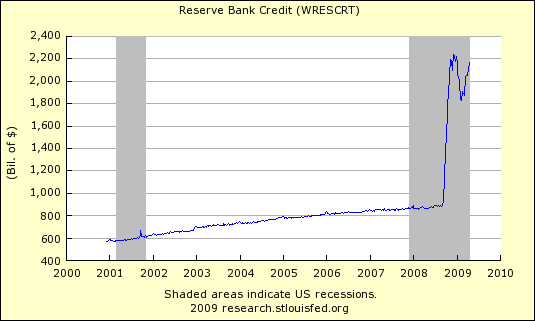
This is the truest measure of Fed liquidity. While Reserve Bank credit has peaked it still remains high and well above trend. This series needs to be watched closely. It is likely that the market will experience a sharp correction when the Fed starts to take out this over abundance of liquidity.

Is the market strong, or is what we are seeing being caused by this aggressive liquidity injection on the part of the Fed. In other words, are we seeing a real case of excessive exuberance?


Reserve Bank credit is the sum of securities held outright, repurchase agreements, term auction credit, other loans, net portfolio holdings of Commercial Paper Funding Facility LLC, net portfolio holdings of LLCs funded through the Money Market Investor Funding Facility, net portfolio holdings of Maiden Lane LLC, net portfolio holdings of Maiden Lane II LLC, net portfolio holdings of Maiden Lane III LLC, float, central bank liquidity swaps, and other Federal Reserve assets.
Subscribe to EF Hutton via Email
Follow E F Hutton on Twitter

Kindle: Amazon's 6" Wireless Reading Device

Saturday, August 01, 2009

Reserve Bank Credit Dropping are Higher Interest Rates on the Near Term Horizon? (Graph)


Reserve Bank Credit is peaking. Reserve credit is down from the peak of $2,236 billions during December, 2008, the secondary top at $2,165 billions during May, 2009. The current reading is $2,010 billions.

This series should be watched closely. The current drop in the dollar could force the Federal Reserve to continue draining reserves from the system to protect the dollar from an all out free fall.

This will likely lead to an increase in long term interest rates. However, it is time to start watching the two year treasury security closely.


Note: Reserve Bank credit is the sum of securities held outright, repurchase agreements, term auction credit, other loans, net portfolio holdings of Commercial Paper Funding Facility LLC, net portfolio holdings of LLCs funded through the Money Market Investor Funding Facility, net portfolio holdings of Maiden Lane LLC, net portfolio holdings of Maiden Lane II LLC, net portfolio holdings of Maiden Lane III LLC, float, central bank liquidity swaps, and other Federal Reserve assets.
Subscribe to EF Hutton via Email
Follow E F Hutton on Twitter

Kindle: Amazon's 6" Wireless Reading Device

Saturday, April 25, 2009

Factors Affecting Reserve Balances Soaring Again(Graph)


Reserve Bank Credit, Factors Affecting Reserve Balances

The Federal Reserve is starting to expand their balance sheet again. Week over Week.
  • The biggest increase this week is in the purchase of Mortgage Backed Securities (MBS) -- up $75 Billion.
  • An additional $18 Billion increase in Maiden Lane LLC (Bear Stearns bailout).
  • An additional $ 34 Billion increase in Maiden Lane II LLC and Maiden Lane III LLC (AIG bailout).
  • U.S. Treasury securities held outright rose $94 Billion, and $405 Billion versus a year ago.
  • Reserve Bank Credit rose $70 Billion week, and $1.3 Trillion versus a year ago.
  • Reserve Bank Credit now stands at $2.169 Trillion and is once again approaching the peak of $2.31 Trillion (December, 2008).

Reserve Bank Credit 424

Notes: H.4.1 Reserve Bank credit is the sum of securities held outright, repurchase agreements, term auction credit, other loans, net portfolio holdings of Commercial Paper Funding Facility LLC, net portfolio holdings of LLCs funded through the Money Market Investor Funding Facility, net portfolio holdings of Maiden Lane LLC, net portfolio holdings of Maiden Lane II LLC, net portfolio holdings of Maiden Lane III LLC, float, central bank liquidity swaps, and other Federal Reserve assets
Subscribe to All American Investor via Email
Bob DeMarco is a citizen journalist and twenty year Wall Street veteran. Bob has written more than 500 articles with more than 11,000 links to his work on the Internet. Content from All American Investor has been syndicated on Reuters, the Wall Street Journal, Fox News, Pluck, Blog Critics, and a growing list of newspaper websites. Bob is actively seeking syndication and writing assignments.


Follow All American Investor on Twitter

Saturday, March 21, 2009

Money Supply continues to Soar (Chart)


Money Suppy320

M2, Money Stock continues to soar and accelerate. Chart current through March 20.
Subscribe to EF Hutton via Email

Wednesday, March 18, 2009

Trend World Protectionism on the Rise


I think most people believe that trade barriers are a bad thing. World protectionism and trade barriers prolonged the recession and impacted trade negatively in the 1930s.

I have to ask myself--have we really learned anything from the past? Or, are we doomed to repeat the same old mistakes?

Seventeen of the G-20 countries recently implemented 47 measures whose effect is to restrict trade at the expense of other countries. I can just hear the analyst on TV--this is no big deal and it won't have a big impact on trade.

These analyst, are the same analyst that, told us over and over that the housing bubble wouldn't have a big effect on the economy or stocks. Right Larry Kudlow? The same analyst that failed to see the interconnectedness of banks and financial companies--as Bear Stears, Lehman, and AIG went down the tube and brought other companies that did business with them to the brink of disaster.

For some reason, analyst have a problem seeing how things are interconnected. They are either dumb, myopic, or in a state of denial like most the country.

You hear the words global economy over and over. There can be no doubt that the world economy is now interconnected. It should be obvious that if one spoke in this interconnectedness breaks the entire wheel stops working. Think of it like the wheel on a bike--when the spoke breaks the wheels gets all wobbly. If you keep riding on the wheel, it will eventually weaken and then collapse. The lesson from this story is, if you fix the broken spoke immediately--the wheel works just fine. But if you keep riding on the bad wheel--it collapses.

There is at the minimum anecdotal evidence that global protectionism is on the rise. What are world leaders and politicians likely to do to satisfy angry constituents when their job is on the line? At first, they will stick a lollipop in the mouth of their constituents. But, if that doesn't work, they will give them what they want to perpetuate themselves in office. This is worrisome.

Over here in the U.S. we are now protecting steel, soon it will be the importation of foreign automobiles, then what? For every action there is likely to be an equal and opposite reaction. These are trends that investors need to be watching. Excessive protectionism could cause the next collapse in stock prices. As an investor you need to keep your eyes and ears open--you really need to pay attention to trends and how they can effect stock prices. Like it says up at the top:
How to make money in the market...think beyond the obvious...spot the trends...and do your homework.


If you would like to read about protectionism go here.
Subscribe to EF Hutton via Email

Thursday, March 05, 2009

Nouriel Roubini Zombie Banks vs. Good Banks


Until banks can get healthy again, markets will continue to spiral downwards, says Jack Bouroudjian, chairman at Capital Markets Technology. Nouriel Roubini, chairman of RGE Monitor joins in the discussion with CNBC's Martin Soong.


Subscribe to EF Hutton via Email

Tuesday, March 03, 2009

'Bad Bank' Funding Plan to Rescue and Move Distressed Assets


Put me down as a fan of this plan. It could end up being a stroke of genius. This definitely trumps the Resolution Trust Corporation (RTC) plan that was used to dispose of the assets from failed Savings and Loans.

Subscribe to EF Hutton via Email
The Obama team announced its intention to partner with the private sector to buy $500 billion to $1 trillion of distressed assets as part of its revamping of the $700 billion bank bailout last month.

...private investment managers would run the funds, deciding which assets to buy and what prices to pay. The government would contribute money from the $700 billion bailout, with additional financing likely coming from the Federal Reserve and by selling government-backed debt. Other investors, such as pension funds, could also participate. To encourage participation, the government would try to minimize risk for private investors, possibly by offering non-recourse loans.

'Bad Bank' Funding Plan Starts to Get Fleshed Out


Bob DeMarco is a citizen journalist, blogger, and Caregiver. In addition to being an experienced writer he taught at the University of Georgia , was an Asociate Director and Limited Partner at Bear Stearns, was CEO of IP Group, and is a mentor. Bob currently resides in Delray Beach, FL where he cares for his mother, Dorothy, who suffers from Alzheimer's disease. Bob has written more than 500 articles with more than 11,000 links to his work on the Internet. His content has been syndicated on Reuters, the Wall Street Journal, Fox News, Pluck, BlogCritics, and a growing list of newspaper websites (15). Bob is actively seeking syndication and writing assignments.


Friday, February 27, 2009

U.S. to Take Big Citi Stake and Overhaul the Board


Main points:
  • We didn't put in any more taxpayer dollars (not yet anyway).
  • The deal addresses the issue of the Board of Directors. The Board will be constructed of new, independent members. I wonder why this took so long?
  • Chief Executive Vikram Pandit keeps his job.
  • If full dilution occurs we the taxpayers end up owning 36 percent of the bank. We are way underwater.
  • The deal boost the bank's tangible common equity ratio. Makes the bank look good for now.

Follow EF Hutton on Twitter
Subscribe to EF Hutton via Email


U.S. to Take Big Citi Stake and Overhaul the Board


U.S. to Take Big Citi Stake and Overhaul the Board

By KEVIN KINGSBURY and MAYA JACKSON RANDALL

Struggling banking giant Citigroup Inc., moving aggressively to shore up its equity base, announced a stock swap Friday that if successful will leave the government owning more than a third of the company and wipe out nearly three-quarters of existing shareholders' stake.

The move is an acknowledgment that more than $50 billion in government capital and a backstop on more than $300 billion in troubled Citigroup assets haven't been enough to stop the bank's slide. It also represents a deepening of the government's role in trying to prop up the U.S. banking sector.

Under the deal, Citigroup said it will offer to convert nearly $27.5 billion in preferred stock sold to private investors and the public and up to $25 billion in preferred stock bought by the government into common stock. The exchange, if fully executed, would leave the U.S. government with 36% of the bank's shares. Existing shareholders' stake would be cut to 26%. Shareholders will have to approve much of the common stock issuance.

Additionally, the government is demanding that the company overhaul its board of directors. Citigroup's board will soon include a majority of new independent directors, the company said Friday. Chief Executive Vikram Pandit is expected to keep his job under the agreement.

The bank's stock plunged on the news.

The terms are onerous for both sides. While common shareholders will see their stakes severely diminished, preferred shareholders are being asked to swap their holdings for riskier common stock, whose holders are the first to get wiped out in times of trouble.

Neither has much choice, however. To motivate investors to sign up, Citigroup is suspending its payment of dividends on preferred stock. And to spur common shareholders to vote for the deal, Citigroup will issue securities to preferred shareholders that agree to the swap that let them buy common stock for a penny a share if shareholders don't approve the deal.

The swap won't involve any additional investment in Citigroup by either the government or the private shareholders, but will boost the bank's tangible common equity ratio, which is closely watched by analysts. It will also relieve the bank of the need to pay more than $5 billion in annual preferred stock dividends.

"This securities exchange has one goal -- to increase our tangible common equity," Chief Executive Vikram Pandit said.
[Citigroup Center in New York] Bloomberg News/Landov

A pedestrian walks past the Citigroup Center in New York.

Separately, Citigroup announced it will record $10 billion in write-downs for the fourth quarter, boosting the year's net loss to $27.7 billion. Citi is also suspending dividend payments on common shares, which had already been slashed to 1 cent a share per quarter.

The conversion rate for swapping the preferred stock to common shares is $3.25, a 32% premium to Thursday's closing price.

The Treasury will only convert its preferred stock into common shares if other preferred-stock holders -- namely sovereign wealth funds that plowed billions into Citigroup in early attempts to bolster capital levels -- also do so. Holders including the Government of Singapore Investment Corp. and longtime shareholder and Saudi Prince Alwaleed Bin Talal are among those of have said they will participate in the exchange.

Treasury said it will match private investors' conversions dollar-for-dollar.

"Treasury will receive the most favorable terms and price offered to any other preferred holder through this exchange," the department added in the statement.

If the maximum conversion levels are hit, that would boost Citi's TCE from the fourth quarter's $29.7 billion to as much as $81 billion.

The agreement marks the third time since October that Washington has come to Citigroup's rescue. Since then, the government has pressured Citigroup to partially break itself up by selling big chunks of its businesses and to overhaul its board. But U.S. ownership has also created a murky situation in which it's unclear who's in charge, leaving Citigroup executives often groping for guidance.

Citigroup will still have to endure the so-called "stress test," which examines banks ability to withstand various chilling economic scenarios, and could be required to raise additional capital.

The company will reconstitute its board to include a majority of new independent directors. It said of the 15 current directors, three will not stand for reelection and two will reach retirement age, and it will announce new directors soon.

Citigroup Chairman Richard Parsons has been scrambling to lure new directors. That has proven an uphill battle, with two candidates Citigroup approached rebuffing the overtures, according to people familiar with the matter.
—Deborah Solomon and David Enrich contributed to this article.

Write to Kevin Kingsbury at kevin.kingsbury@dowjones.com and Maya Jackson Randall at Maya.Jackson-Randall@dowjones.com

Follow us on Twitter

Bob DeMarco is a citizen journalist, blogger, and Caregiver. In addition to being an experienced writer he taught at the University of Georgia , managed on Wall Street at Bear Stearns, was CEO of IP Group, and is a mentor. Bob currently resides in Delray Beach, FL where he cares for his mother, Dorothy, who suffers from Alzheimer's disease. Bob has written more than 500 articles with more than 11,000 links to his work on the Internet. His content has been syndicated on Reuters, the Wall Street Journal, Fox News, Pluck, BlogCritics, and a growing list of newspaper websites (15). Bob is actively seeking writing assignments and syndication.


More from All American Investor


Sunday, February 22, 2009

Zombie Bank


A Zombie Bank refers to a bank with a net worth which is less than zero, but which continues to operate because of implicit or explicit government guarantee.
On paper, Gotham has $2 trillion in assets and $1.9 trillion in liabilities, so that it has a net worth of $100 billion. But a substantial fraction of its assets — say, $400 billion worth — are mortgage-backed securities and other toxic waste. If the bank tried to sell these assets, it would get no more than $200 billion.

So Gotham is a zombie bank: it’s still operating, but the reality is that it has already gone bust. Its stock isn’t totally worthless — it still has a market capitalization of $20 billion — but that value is entirely based on the hope that shareholders will be rescued by a government bailout.--Paul Krugman
In the continuing series on the lexicon of financial misfortune, Morning Edition introduces the term "zombie bank." A zombie bank keeps draining bailout capital from the government but doesn't respond with any meaningful lending that helps the economy recover. The prevalence of zombie banks made the long Japanese recession of the 1990s especially painful. --Zombie Banks Feed Off Bailout Money/NPR/Listen
The global recession manifests itself in big and small ways, most gloomy, some quirky and often reflecting the inventive human spirit. Here is a look at some signs of the times.--Zombie banks return
Subscribe to All American Investor via Email

Wall Street Voodoo


By PAUL KRUGMAN
Old-fashioned voodoo economics — the belief in tax-cut magic — has been banished from civilized discourse. The supply-side cult has shrunk to the point that it contains only cranks, charlatans, and Republicans.

But recent news reports suggest that many influential people, including Federal Reserve officials, bank regulators, and, possibly, members of the incoming Obama administration, have become devotees of a new kind of voodoo: the belief that by performing elaborate financial rituals we can keep dead banks walking.

To explain the issue, let me describe the position of a hypothetical bank that I’ll call Gothamgroup, or Gotham for short.

On paper, Gotham has $2 trillion in assets and $1.9 trillion in liabilities, so that it has a net worth of $100 billion. But a substantial fraction of its assets — say, $400 billion worth — are mortgage-backed securities and other toxic waste. If the bank tried to sell these assets, it would get no more than $200 billion.

So Gotham is a zombie bank: it’s still operating, but the reality is that it has already gone bust. Its stock isn’t totally worthless — it still has a market capitalization of $20 billion — but that value is entirely based on the hope that shareholders will be rescued by a government bailout.

Why would the government bail Gotham out? Because it plays a central role in the financial system. When Lehman was allowed to fail, financial markets froze, and for a few weeks the world economy teetered on the edge of collapse. Since we don’t want a repeat performance, Gotham has to be kept functioning. But how can that be done?

Well, the government could simply give Gotham a couple of hundred billion dollars, enough to make it solvent again. But this would, of course, be a huge gift to Gotham’s current shareholders — and it would also encourage excessive risk-taking in the future. Still, the possibility of such a gift is what’s now supporting Gotham’s stock price.

A better approach would be to do what the government did with zombie savings and loans at the end of the 1980s: it seized the defunct banks, cleaning out the shareholders. Then it transferred their bad assets to a special institution, the Resolution Trust Corporation; paid off enough of the banks’ debts to make them solvent; and sold the fixed-up banks to new owners.

The current buzz suggests, however, that policy makers aren’t willing to take either of these approaches. Instead, they’re reportedly gravitating toward a compromise approach: moving toxic waste from private banks’ balance sheets to a publicly owned “bad bank” or “aggregator bank” that would resemble the Resolution Trust Corporation, but without seizing the banks first.

Sheila Bair, the chairwoman of the Federal Deposit Insurance Corporation, recently tried to describe how this would work: “The aggregator bank would buy the assets at fair value.” But what does “fair value” mean?

In my example, Gothamgroup is insolvent because the alleged $400 billion of toxic waste on its books is actually worth only $200 billion. The only way a government purchase of that toxic waste can make Gotham solvent again is if the government pays much more than private buyers are willing to offer.

Now, maybe private buyers aren’t willing to pay what toxic waste is really worth: “We don’t have really any rational pricing right now for some of these asset categories,” Ms. Bair says. But should the government be in the business of declaring that it knows better than the market what assets are worth? And is it really likely that paying “fair value,” whatever that means, would be enough to make Gotham solvent again?

What I suspect is that policy makers — possibly without realizing it — are gearing up to attempt a bait-and-switch: a policy that looks like the cleanup of the savings and loans, but in practice amounts to making huge gifts to bank shareholders at taxpayer expense, disguised as “fair value” purchases of toxic assets.

Why go through these contortions? The answer seems to be that Washington remains deathly afraid of the N-word — nationalization. The truth is that Gothamgroup and its sister institutions are already wards of the state, utterly dependent on taxpayer support; but nobody wants to recognize that fact and implement the obvious solution: an explicit, though temporary, government takeover. Hence the popularity of the new voodoo, which claims, as I said, that elaborate financial rituals can reanimate dead banks.

Unfortunately, the price of this retreat into superstition may be high. I hope I’m wrong, but I suspect that taxpayers are about to get another raw deal — and that we’re about to get another financial rescue plan that fails to do the job.


More from All American Investor


Thursday, February 19, 2009

Roubini on Housing, Stimulus and Banks


Dr. Roubini discusses the housing recovery plan, bank bailouts, and the shape of the coming recession. His comments on the stimulus package and housing plan are mostly negative.

Is Roubini right on? Or is he becoming like the little boy crying wolf?

Subscribe to EF Hutton via Email
Source: Firedoglake

Tuesday, December 30, 2008

Nikkei Up on Last Session of 2008, Logs Worst Year Ever


Japan's Nikkei 225 Average fell 42 percent in 2008, the worst loss in its 58-year history, though the benchmark gained 1.3 percent on its final half-day of trade.

Its annual losses were the worst ever, surpassing the 38.7 percent tumble marked in 1990.
Subscribe to EF Hutton via Email

Follow EF Hutton on Twitter


Nikkei Up on Last Session of 2008, Logs Worst Year Ever

Japan's Nikkei 225 Average fell 42 percent in 2008, the worst loss in its 58-year history, though the benchmark gained 1.3 percent on its final half-day of trade.

Canon and other exporters gained as the dollar rose slightly against the yen before falling back, while oil and gas field developer Inpex climbed as oil extended gains on concern that Israeli attacks on Gaza could disrupt Middle East crude oil supplies.

Toyota Motor bucked the trend by slipping 1 percent, badly hit like the rest of the auto sector -- one of the Tokyo market's worst performing sectors this year -- by the worsening global economy. The Nikkei gained 112.39 points on Tuesday and rose 4
percent for December, its first positive month since May. But its annual losses were the worst ever, surpassing the 38.7 percent tumble marked in 1990.

The broader Topix index gained 0.5 percent on Tuesday to 859.24 but was also down 42 percent for the year. Trade will resume on Jan 5.

Market players forecast a tough 2009 but said that hopes of further economic stimulus packages to stem the worsening of the global economy were providing some lift.

"Everyone's pinning their hopes on economic stimulus policies by the United States and possibly China, which is keeping the market supported for now," said Tomomi Yamashita, a fund manager at Shinkin Asset Management.

"But people aren't watching things like company results as closely as they should be. We can't say for sure that the market's bottomed out until we see these next spring."

In one possible sign of things to come, shares of Sharp edged down 0.3 percent to 636 yen after the Nikkei business daily said the consumer electronics maker will book an extraordinary loss of more than 50 billion yen ($555 million) for the year to March 31, largely due to an impairment loss on its stake in Pioneer.

But other market players said the worst was likely over.

"The main problems in the United States are being tackled one by one, meaning a lot of uncertainties are being removed," said Hideyuki Ishiguro, a supervisor in the investment strategy division at Okasan Securities.

"The market has also factored in the various company losses this quarter and the gloomy predictions for next quarter, so these alone are unlikely to send it to new lows."

The U.S. government said on Monday it was pumping $5 billion into auto and mortgage lender GMAC LLC and lending up to $1 billion to automaker General Motors, ensuring the solvency of a company considered crucial to GM's survival and providing some marginal support to Tokyo shares.

Resources Shares Climb, Exporters Up

Oil prices rose after surging more than $2 on Monday amid concern that Israeli attacks on Gaza, which continued on Tuesday as Israeli aircraft fired missiles at government buildings in the Gaza Strip, could disrupt Middle East crude oil supplies.

More From CNBC.com
# Get After-the-Bell Dow 30 Quotes
# Credit Spreads and Libor Data
# Futures and Pre-Market Data
# Currency Data

Resource-linked shares such as Mitsubishi Corp and other trading houses climbed as a result.

Mitsubishi Corp, Japan's largest trading house, rose 2.8 percent to 1,238 yen and fellow trader Mitsui & Co gained 3 percent to 901 yen. Itochu Corp gained 1.8 percent to 443 yen. Oil and gas field developer Inpex surged 5.1 percent to 698,000 yen.

Blue-chip exporters rose as well, with Sony gaining 1.2 percent to 1,922 yen and Canon rising 2.8 percent to 2,770 yen.

But Toyota slipped 1 percent to 2,905 yen, though fellow automakers Honda Motor and Nissan Motor both rose.

Trade picked up on the Tokyo exchange's first section, with 854 million shares changing hands, compared with last week's morning average of 597 million. Advancing stocks outpaced declining ones by nearly 3 to 1.
Copyright 2008 Reuters. Click for restrictions.

URL: http://www.cnbc.com/id/28429197/