Showing posts with label dollar. Show all posts

Monday, July 20, 2009

Dollar Index Approaching Near Term Support and Lows (Chart)


Subscribe to EF Hutton via Email

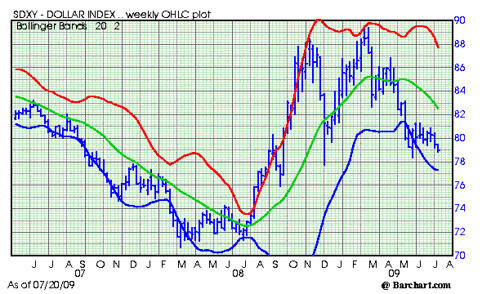
The Dollar Index (DI) is approaching its near term low of 78.34 made back in June, and 77.68 in December.

Back in March, a breakdown in the DI signaled a big break in the stock market. Will history repeat itself?

THE DI is a somewhat oversold here, so it should hold in short term.

This area and the resulting trade should be watched closely by investors.

The DI traded down to 70.69 in March.

Dollar Index Weekly Chart

Dollar Index Weekly Chart 720


Kindle: Amazon's 6" Wireless Reading Device

Thursday, June 18, 2009

Paul Samuelson Warns: China will turn pessimistic on the U.S. dollar


These are sobering words from renowned economist Paul Samuelson.

Some day -- maybe even soon -- China will turn pessimistic on the U.S. dollar.

That means lethal troubles for the future U.S. economy.

When a disorderly run against the dollar occurs, I believe a truly global financial panic is to be feared. China, Japan and Korea now hold dollars not because they think dollars will stay safe.

Why then?.....
The threat that China and others might divest the dollar is starting to cause jitters in the Treasury market. If the countries he mentions held on to their dollar assets --but cut back on their purchases of U.S. Treasuries-- interest rates would spike straight up over a short period of time. The given in this equation is that the amounts of Treasuries coming on the market in the years ahead is enormous.

Growing supply, and the likelihood that U. S. Treasury debt will get downgraded, means that the risk premium for owning longer dated treasuries is likely to rise and rise sharply. During that early 1990s this risk premium rose to more than five percent.

So lets say we find ourselves with a three percent inflation rate in the next 12-18 months. What is the rate we could see in the ten years treasury?

8-11 percent. Inflation, inflation expectation, dollar risk, supply, plus a fair rate of interest. It is not hard to envision five or more points of risk premium.

Does it make good sense in this environment to be fully invested in stocks?

My guess is that we are going to see a sharp uptick in inflation in the next 12-18 months. Given the enormous expansion in the money supply it is not hard to envision three percent inflation. Add in the necessary risk premium for owning longer dated securities, and it is not hard to envision sharply higher rates.

Right now most analysts continue to mention how inflation is not a problem. In 1980, when inflation was hitting 1.5 percent per month analysts were forecasting higher inflation and higher interest rates right into the peak.

Are we at the trough in inflation now? Is inflation bottoming?

Anybody old enough to remember when the ten year treasury yield was above 15 percent?

Three month treasury bill at 14 percent?

It is time to be risk adverse. Not the time to be betting the ranch in the stock market.

To read the entire Samuelson article go here.
Subscribe to EF Hutton via Email

Bob DeMarco is a citizen journalist and twenty year Wall Street veteran. Bob has written more than 500 articles with more than 11,000 links to his work on the Internet. Content from All American Investor has been syndicated on Reuters, the Wall Street Journal, Fox News, Pluck, Blog Critics, and a growing list of newspaper websites. Bob is actively seeking syndication and writing assignments.


Follow E F Hutton on Twitter

Kindle: Amazon's 6" Wireless Reading Device

Friday, May 15, 2009

Roubini on the U.S. Dollar and the Chinese Yuan


The Almighty Renminbi?

Now, imagine a world in which China could borrow and lend internationally in its own currency. The renminbi, rather than the dollar, could eventually become a means of payment in trade and a unit of account in pricing imports and exports, as well as a store of value for wealth by international investors. Americans would pay the price. We would have to shell out more for imported goods, and interest rates on both private and public debt would rise. The higher private cost of borrowing could lead to weaker consumption and investment, and slower growth.
Also see Roubini vs. Zhou on the U.S. Dollar and the Chinese Yuan
Subscribe to EF Hutton via Email


Bob DeMarco is a citizen journalist and twenty year Wall Street veteran. Bob has written more than 500 articles with more than 11,000 links to his work on the Internet. Content from All American Investor has been syndicated on Reuters, the Wall Street Journal, Fox News, Pluck, Blog Critics, and a growing list of newspaper websites. Bob is actively seeking syndication and writing assignments.


Follow E F Hutton on Twitter

Wednesday, May 13, 2009

Trade Weighted Dollar Dropping (Graph)


You may be wondering why I put this chart up.

When the trade weighted value of the dollar drops the price we pay for imported goods goes up.

This helps explain why oil and commodity prices are now surging. When you look at this chart it might not seem like the current drop is severe. However, the trade weighted exchange value of the dollar has dropped about 4 percent in the last 45 days.

Take a look at how this is effecting oil, commodity prices, and interest rates.

We will keep you posted on this one.

Subscribe to EF Hutton via Email

Follow E F Hutton on Twitter

Saturday, March 21, 2009

Dollar Index Turning Down (Chart and Analysis)


Dollar Index March 2009


After the Treasury announcement this week, the dollar index traded sharply lower. Along with this, oil and commodity prices moved higher as should be expected.

The market is currently in a downside range expansion. The sharp trade below the blue line (two standard deviations down from the mid point) indicates that the market is oversold and due for a correction or consolidation on a short term basis. If the dollar index fails to regain the 84.00 level and hold, it would be a major negative. The trend is turning down.

The longer term chart of the Dollar Index indicates a major double top with an extended right top that found no new buyers. This is potentially extremely negative. We will put that chart up tomorrow with some analysis.
Subscribe to EF Hutton via Email

Dollar versus Euro Exchange Rate (Chart)


The chart has an interesting long term double bottom. The chart is evidencing a fear of inflation in the U. S. Along with the Chart on Money Supply, M2, these series should be watched closely.
Subscribe to EF Hutton via Email

Sunday, March 15, 2009

Trade Weighted Dollar Index Chart


A weighted average of the foreign exchange value of the U.S. dollar against the currencies of a broad group of major U.S. trading partners.

Broad currency index includes the Euro Area, Canada, Japan, Mexico, China, United Kingdom, Taiwan, Korea, Singapore, Hong Kong, Malaysia, Brazil, Switzerland, Thailand, Philippines, Australia, Indonesia, India, Israel, Saudi Arabia, Russia, Sweden, Argentina, Venezuela, Chile and Colombia.

For more information about trade-weighted indexes see http://www.federalreserve.gov/pubs/bulletin/2005/winter05_index.pdf.

Subscribe to EF Hutton via Email


Sunday, March 08, 2009

Rogers Bullish on China, Bearish on the Dollar


China to Overcome Global Recession First, Rogers Says

China’s stimulus spending will help its economy overcome the global recession sooner than the U.S. and other countries, investor Jim Rogers said.
“I certainly expect China to come out of it sooner than the U.S.,” Rogers, chairman of Singapore-based Rogers Holdings, said in a Bloomberg TV interview in the city-state. “They seem to be spending the money on the right things. China is doing a far better job than the others.”
“I plan later this year to get out of the rest of my U.S. dollars,” he said. “It’s had an artificial rally too but it’s a terribly flawed currency. The U.S. is printing money as fast as it can and that’s always throughout history led to currency problems down the road.”
Subscribe to EF Hutton via Email

Tuesday, May 13, 2008

CNBC Million Dollar Portfolio Challenge Bonus Bucks Answers


5. Street Signs

According to Rebecca Darst, what “slammed” the Pawn-and-Payday firms?

Answer: wham-bam legislation


4. Power Lunch

On May 9’s “Stop Trading”, Jim Cramer warned NOT to buy certain stocks. Which one did he call a “travesty”?

Answer: AIG


3. The Call

On May 5, strategist James Altucher said three stocks may be the “next Berkshire Hathaways.” Name one of them.

Answer: Otter Tail


CNBC Million Dollar Portfolio Challenge Bonus Bucks Answers for Tuesday, May 13, 2008

1. Squawk Box

On May 5, analyst Elaine Kub discussed a possible commodity cartel. What commodity was it?

Answer: Rice

2. Squawk on the Street

On May 9, what did John Kilduff say was his upside target for crude oil?

Answer: $138


3. The Call

On May 5, strategist James Altucher said three stocks may be the “next Berkshire Hathaways.” Name one of them.

Answer: Otter Tail


4. Power Lunch

On May 9’s “Stop Trading”, Jim Cramer warned NOT to buy certain stocks. Which one did he call a “travesty”?

Answer: AIG


5. Street Signs

According to Rebecca Darst, what “slammed” the Pawn-and-Payday firms?

Answer: wham-bam legislation


CNBC Bonus Bucks Answers for Tuesday, May 13, 2008


1. Squawk Box

On May 5, analyst Elaine Kub discussed a possible commodity cartel. What commodity was it?

Answer: Rice

Get Notification of CNBC Bonus Bucks Answers via Email


Get Notification of CNBC Bonus Bucks Answers via Email