Showing posts with label loans. Show all posts

Saturday, August 01, 2009

Reserve Bank Credit Dropping are Higher Interest Rates on the Near Term Horizon? (Graph)


Reserve Bank Credit is peaking. Reserve credit is down from the peak of $2,236 billions during December, 2008, the secondary top at $2,165 billions during May, 2009. The current reading is $2,010 billions.

This series should be watched closely. The current drop in the dollar could force the Federal Reserve to continue draining reserves from the system to protect the dollar from an all out free fall.

This will likely lead to an increase in long term interest rates. However, it is time to start watching the two year treasury security closely.


Note: Reserve Bank credit is the sum of securities held outright, repurchase agreements, term auction credit, other loans, net portfolio holdings of Commercial Paper Funding Facility LLC, net portfolio holdings of LLCs funded through the Money Market Investor Funding Facility, net portfolio holdings of Maiden Lane LLC, net portfolio holdings of Maiden Lane II LLC, net portfolio holdings of Maiden Lane III LLC, float, central bank liquidity swaps, and other Federal Reserve assets.
Subscribe to EF Hutton via Email
Follow E F Hutton on Twitter

Kindle: Amazon's 6" Wireless Reading Device

Thursday, June 18, 2009

Mortgage Refinance and Loan Market Deteriorates


Are higher interesting rates effecting refinancing? Is the Housing Market picking up?

Refinancing
  • The Refinance Index dropped 23.3 percent to 1998.1 from 2605.7.
  • The four week moving average for the seasonally adjusted Refinance Index is down 19.6 percent.
  • The refinance share of mortgage activity decreased to 54.1 percent of total applications from 59.4 percent the previous week.
Mortgage Loans
  • The Market Composite Index, a measure of mortgage loan application volume, was 514.4, a decrease of 15.8 percent on a seasonally adjusted basis from 611.0 one week earlier.
  • The four week moving average for the seasonally adjusted Market Index is down 13.5 percent. The Purchase Index decreased 3.5 percent to 261.2 from 270.7 one week earlier.
***Mortgage Bankers Association (MBA)Weekly Mortgage Applications Survey for the week ending June 12, 2009.
Subscribe to EF Hutton via Email


Kindle: Amazon's 6" Wireless Reading Device

Tuesday, June 09, 2009

The Housing and Credit Crisis Explained


This presentation on the Housing and Credit crisis is the best I have seen. It explains everything from soup to nuts.

Each slide contains a graph that is well explained.

They say a picture is worth a thousand words.

Once you get through this, you will understanding the current credit crisis in housing, and what to expect in the years ahead.

If you take the time to view and read this you will be fully informed.

Hit the full screen button in the upper right hand corner of the panel below.

T2 Partners Presentation on the Mortgage Crisis

Subscribe to All American Investor via Email


Bob DeMarco is a citizen journalist and twenty year Wall Street veteran. Bob has written more than 500 articles with more than 11,000 links to his work on the Internet. Content from All American Investor has been syndicated on Reuters, the Wall Street Journal, Fox News, Pluck, Blog Critics, and a growing list of newspaper websites. Bob is actively seeking syndication and writing assignments.


More from All American Investor

Kindle: Amazon's 6" Wireless Reading Device

Monday, May 25, 2009

Fed UP UP and Away (Chart)


Net Free and Borrowed Reserves Soaring. M2, Money Supply Soaring. Monetary Base Soaring. Fed Balance sheet Soaring. Nonperforming loans Soaring.

Long term interest rates rising. Mortgage interest rates rising. Stocks topping and weakening. Gold surging.

Bull market in stocks? Not likely in the short term. It is getting more risky by the week.


Subscribe to All American Investor via Email

Bob DeMarco is a citizen journalist and twenty year Wall Street veteran. Bob has written more than 500 articles with more than 11,000 links to his work on the Internet. Content from All American Investor has been syndicated on Reuters, the Wall Street Journal, Fox News, Pluck, Blog Critics, and a growing list of newspaper websites. Bob is actively seeking syndication and writing assignments.

More from All American Investor

Thursday, May 21, 2009

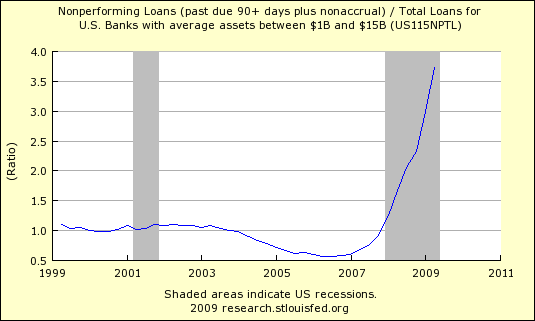
Nonperforming Loans Chart -- Get Under Your Desk


NonPerforming Loans, Banks, Chart

Non Performing Loans 521
Subscribe to All American Investor via Email
When I looked at this chart this thought came to my mind -- get under your desk.

Nonperforming loans have more than doubled, year over year.

Wonder why stocks are shaky and gold is soaring. This is one reason.

This is not the kind of information that creates confidence. When uncertainty creeps into the market, stocks go down.
Bob DeMarco is a citizen journalist and twenty year Wall Street veteran. Bob has written more than 500 articles with more than 11,000 links to his work on the Internet. Content from All American Investor has been syndicated on Reuters, the Wall Street Journal, Fox News, Pluck, Blog Critics, and a growing list of newspaper websites. Bob is actively seeking syndication and writing assignments.


Kindle: Amazon's Wireless Reading Device (Latest Generation)


Follow All American Investor on Twitter

Wednesday, March 25, 2009

Roubini on PIPP


Nouriel RubiniI received this via email from the RGE Monitor.

The following is a a extract and the complete text is included below.

Bottom line: Will it get credit flowing again?

The immediate market reaction (equities and investment grade CDS staged a substantial rally, less so high yield CDS) was clearly one of relief that nationalization seems to be off the table for now and that the administration is committed to market-based solutions. While the extent of the guarantees almost makes one wonder why the involvement of the private sector is needed in the first place, it is the involvement of the private sector that creates a context in which price setting and discovery happen based on a market mechanism.

An important question at this point is: What should we look at while assessing the plan in the months ahead?

Clearly the unfreeze of credit markets would be the first sign of success but we might not see this happening before some time. Some of the banks that choose to sell assets and take a writedown might be in need of additional capital before they can resume lending. Also, for those institutions that are beyond the stage of rescue and effectively insolvent, the plan will likely not be as effective in stimulating lending or participation in the first place.

The increase in the supply of credit that will come from institutions that are solvent will be important, but will demand be there to do its part? If the real side of the economy continues to deteriorate, it is likely that credit demand might be subdued. Moreover, a further continued deterioration on the real side of the economy would imply new defaults on credit cards, consumer loans, auto loans and mortgages that would result in new toxic assets on the balance sheets of financial institutions recreating an environment where banks would maintain stringent lending standards. Therefore, the success of the plan is a necessary but not sufficient condition to get the economy back on a recovery path. The success of the fiscal stimulus package in sustaining aggregate demand and minimizing job losses and the success in restarting demand in the housing sector will be instrumental to put a stop to the negative feedback loop between the real and the financial side of the economy.

Moreover, if the negative feedback loop persists, need for further funding will arise. While it will be very challenging to obtain Congress approval for additional TARP money, we should point out that the government has set aside an additional $750bn in the FY2010 budget in aid for the financial sector.

Hence, taking care of legacy loans and securities is a welcome step forward, especially for solvent institutions whose asset values are subject to a substantial liquidity discount. However, insolvent institutions might not find as much relief from this plan, and the impact of the plan on the real economy might not be enough to pull the economy out of a contraction for good part of this year and sluggish growth thereafter. But by conducting auctions and determining the market value of the toxic assets, the Treasury will be implicitly using the private sector to ‘stress test’ the financial system to determine which banks are insolvent and therefore will need further government intervention.
Subscribe to EF Hutton via Email

The main components of Treasury Secretary Geithner’s new PPIP to price and remove toxic assets from banks’ balance sheets are as follows:

Basic Principles: Treasury will use $75bn - $100bn in TARP money to co-invest alongside private sector participants and the FDIC as well as the Federal Reserve, to buy $500bn to $1 trillion of toxic mortgage assets (both residential and commercial) off banks’ books (‘legacy assets’)

There are two separate approaches for legacy loans and for legacy securities. At first, Treasury will share its $75-100bn equity stake equally between the two programs with the option to shift the bulk of financing towards the option with the greater promise of success with market participants.

1) Public-Private Program for Legacy Loans: The FDIC establishes several public-private investment funds whose sole purpose will be to purchase and hold specific loan pools put up for sale by banks (large and small). The transaction price will be established by the highest bid at an auction run by the FDIC, in which a wide array of institutional investors and even individuals with a long-term orientation are encouraged to participate. The liabilities of the investment fund consist of an equity stake (50% of which provided by auction winner, 50% from Treasury TARP), and collateralized debt issued by the investment fund and guaranteed by the FDIC to finance the remainder of the purchase price (FDIC gets guarantee fee). Before the auction, the FDIC specifies the pool-specific debt-to-equity ratio it is willing to guarantee subject to a maximum 6-to-1 leverage ratio. The private investor would then manage the servicing of the asset pool - using asset managers approved and supervised by the FDIC - until disposal or maturity.

Example: Assuming a 6-to-1 debt-to-equity ratio, the highest bid for a loan pool with $100 face value might turn out to be $84. Of this amount, the FDIC would provide $72 in debt guarantees whereas the equity stake of $12 would be shared equally between the auction winner ($6) and the Treasury ($6).

2) Legacy Securities Program: The legacy securities program is to be incorporated into the Term Asset-Backed Securities Facility (TALF) whose original goal was to provide collateralized financing (non-recourse loans) to buyers of newly created consumer loan/small business loan ABS. Under the Legacy Securities Program, the eligible collateral for TALF is extended to include non-agency RMBS that were originally rated AAA and outstanding CMBS and ABS that are rated AAA.

Example: Under the Legacy Securities Program, up to five Treasury-approved fund managers will have a period of time to raise private capital to target the purchase of designated securities. Assuming the fund manager is able to raise $100 of private capital for the fund, Treasury will provide $100 equity co-investment alongside private investors. Treasury will then provide a $100 loan to the public-private investment fund. Moreover, Treasury may also choose to provide an additional loan of up to $100 to the fund. The investment fund then has $300-$400 at its disposal to buy legacy securities at its discretion. As a purchaser of TALF-eligible securities, the PPIF would also have access to the expanded TALF program of collateralized Fed loans when it is launched.

Assessment

The main sticking points in previous market-based approaches to clear toxic assets from banks’ books were threefold:

a) How to value illiquid assets?
b) Once a transaction price is established, will banks be willing to sell and take a hair cut?
c) How to induce private investors to purchase legacy assets without unduly wasting taxpayer money?

a) Valuation of Illiquid Assets

The theoretical foundations of Geithner’s plan are provided by Lucian Bebchuk from Harvard University among others. He explains that “if the underlying market failure is at least partly one of liquidity, an effective plan for a public-private partnership in buying troubled assets can be designed. The key is to have competition at two levels.First, at the level of buying troubled assets, the government’s program should focus on establishing many competing funds that are privately managed and partly funded with private capital--and not creating one, large "aggregator bank"-- funded with public and private capital and engaging in purchasing troubled assets. Second, several potential fund managers should compete for government capital under a market mechanism resulting in maximum participation of private capital and minimum costs to taxpayers.”

Geithner’s plan seems to follow these guidelines to a large degree. In particular, on the one hand the government subsidy allows private investors to bid a higher price than otherwise warranted (i.e. the government gives investors the equivalent of a call option.) On the other hand, the fact that the private investor is bound to lose its entire equity stake if the asset value deteriorates from artificially high valuations provides an incentive to bid conservatively. Both effects together may contribute to a reasonable level of price discovery. In case of the securities program, the prospect of refinancing purchased legacy securities with TALF via a non-recourse loan (which is the equivalent of a put option) should incentivize private investors to bid higher than otherwise warranted.

b) Will banks participate?

A similar purely private solution to get toxic assets off banks’ balance sheets was tried with Paulson’s aborted Super-SIV when legacy assets were still marked substantially higher than at present. It became clear then that the private sector will require a possibly substantial taxpayer subsidy in order to overcome the collective action paralysis. Indeed, in the case of the legacy loan example outlined in the Geithner plan with a 6/1 leverage, private investors that invest 7.1% (=1/7 * 0.5) of the equity will get 50% of any upside in return. While Treasury will also share in any upside by half, any downside beyond the private investors’ equity stake is clearly borne by the taxpayers.

While this subsidy to investors provides a powerful incentive to bid prices up in a competitive auction, banks stuck with particularly toxic assets or thin capital buffers may still find a potential writedown at market-clearing prices prohibitive and some might need to be recapitalized after taking the hair cut. FDIC Chairman Sheila Bair has already warned that while this plan will help many solvent banks get rid of their toxic assets thus clearing the way for new loans and fresh capital some banks are beyond the stage of rescue. Those borderline insolvent banks will likely require an additional incentive to sell or mandatory participation otherwise they will prefer to hold on to their assets, especially in view of the FASB’s prospective easing of mark-to-market accounting rules.

For the sake completeness, some commentators would also like to see better safeguards established in order to prevent banks and asset managers from potentially colluding in their common interest to the detriment of the taxpayer.

c) And taxpayers?

At the end of the day the performance of the toxic legacy assets is driven by the cash flow performance of the underlying loans. Keep in mind that among subprime borrowers, serious delinquencies and foreclosures have affected about 20% of outstanding loans as of December 2008 thus impairing the cash flow directed to junior RMBS investors and/or ABS CDOs consisting of these junior tranches. While ABX prices responded positively to the prospect of increased buyer interest, the ultimate loan value will depend on whether households and commercial real estate borrowers will continue making payments in the future. More on that below.

As a practical example of the performance of a toxic portfolio, take the Fed’s Maiden Lane portfolio with Bear Stearns assets. Cumberland Advisors reported that so far the results aren’t promising, and they see no prospect for a profit on the assets. In fact, the portfolio has lost over 10% of its value, and losses are mounting. At present, losses on that portfolio exceed $4.5 billion and the taxpayers’ share is now $3.5 billion. Others point to the low recovery value of IndyMac’s mortgage portfolio as a benchmark.


Bottom line: Will it get credit flowing again?

The immediate market reaction (equities and investment grade CDS staged a substantial rally, less so high yield CDS) was clearly one of relief that nationalization seems to be off the table for now and that the administration is committed to market-based solutions. While the extent of the guarantees almost makes one wonder why the involvement of the private sector is needed in the first place, it is the involvement of the private sector that creates a context in which price setting and discovery happen based on a market mechanism.

An important question at this point is: What should we look at while assessing the plan in the months ahead?

Clearly the unfreeze of credit markets would be the first sign of success but we might not see this happening before some time. Some of the banks that choose to sell assets and take a writedown might be in need of additional capital before they can resume lending. Also, for those institutions that are beyond the stage of rescue and effectively insolvent, the plan will likely not be as effective in stimulating lending or participation in the first place.

The increase in the supply of credit that will come from institutions that are solvent will be important, but will demand be there to do its part? If the real side of the economy continues to deteriorate, it is likely that credit demand might be subdued. Moreover, a further continued deterioration on the real side of the economy would imply new defaults on credit cards, consumer loans, auto loans and mortgages that would result in new toxic assets on the balance sheets of financial institutions recreating an environment where banks would maintain stringent lending standards. Therefore, the success of the plan is a necessary but not sufficient condition to get the economy back on a recovery path. The success of the fiscal stimulus package in sustaining aggregate demand and minimizing job losses and the success in restarting demand in the housing sector will be instrumental to put a stop to the negative feedback loop between the real and the financial side of the economy.

Moreover, if the negative feedback loop persists, need for further funding will arise. While it will be very challenging to obtain Congress approval for additional TARP money, we should point out that the government has set aside an additional $750bn in the FY2010 budget in aid for the financial sector.

Hence, taking care of legacy loans and securities is a welcome step forward, especially for solvent institutions whose asset values are subject to a substantial liquidity discount. However, insolvent institutions might not find as much relief from this plan, and the impact of the plan on the real economy might not be enough to pull the economy out of a contraction for good part of this year and sluggish growth thereafter. But by conducting auctions and determining the market value of the toxic assets, the Treasury will be implicitly using the private sector to ‘stress test’ the financial system to determine which banks are insolvent and therefore will need further government intervention.

Contact RGE Sales
Phone: 212.645.0010
E-mail: sales@rgemonitor.com
RGE Monitor | 131 Varick Street, Suite 1005 | New York, New York 10013
Tel: 212.645.0010 | Fax: 212.645.0023