Showing posts with label stock. Show all posts

Thursday, May 07, 2009

They called me crazy, S and P 900-1000 (Part Two)


When I wrote Stocks Don't Fight the Tape the S and P 500 was around 768. I predicted a rally into the 900-1000 area.

I followed that up with They called me crazy, S and P 900-1000

What next?

S and P 500 Chart 507
  • The stock market is currently overbought.
  • The technical correction in the current bear market is two months old.
  • A major retracement to the downside is likely, and is imminent.
  • We could see additional upside to the 940 area versus the S and P 500.
  • A test of the 840 area is likely.
  • Once the correction gets underway we should get a better understanding of the structure of the market. Begining of long term bull, or bear market still in tact?
  • The important 200 day average is still about 100 points above the market and the down ward slope of that average is becoming more severe. This is not a good sign.
The bottom line. The risks out weigh the rewards at this level.

This has been a tremendous rally that I expected. However, in terms of price and duration it fits the requirements for a correction in a market that is still trending down.

In addition, the longer dated treasury interest rates are turning up. This is a negative. The dollar looks very vulnerable right now. Another negative. The combination of rising rates in the long end and a dropping dollar does not bode well for stocks.
Subscribe to All American Investor via Email
Bob DeMarco is a citizen journalist and twenty year Wall Street veteran. Bob has written more than 500 articles with more than 11,000 links to his work on the Internet. Content from All American Investor has been syndicated on Reuters, the Wall Street Journal, Fox News, Pluck, Blog Critics, and a growing list of newspaper websites. Bob is actively seeking syndication and writing assignments.


Follow All American Investor on Twitter

Sunday, March 29, 2009

Amazon . Toast (AMZN) up 5000 percent since IPO (Chart)


From All American Investor

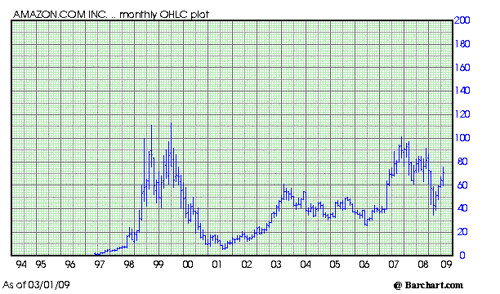
Amazon (AMZN), Ten Year Chart, Monthly.

In May, 1997 Amazon (AMZN) was labeled Amazon.toast and Amazon.bomb by Forrester Research and Barron's. Since then it has risen more than 5,000 percent.

Amazon Chart Ten Year 328Align Center

Highlights:
  • Amazon was founded in 1994, and went public in 1997.
  • In 1997, Amazon was labeled Amazon.toast and Amazon.bomb by Forrester Research and Barron's.
  • By 1999, cumulative losses at Amazon exceeded $550 million.
  • In December, 1999, Jeff Bezos was chosen as Time magazine's person of the year (see Cover).
  • In December 1999, Amazon reached its highest raw price in history at $113 a share.
  • In the summer of 2000, an analyst at Lehman Brothers warned investors that the company might run out of cash and advised them to avoid its stock.
  • In September 2001, Amazon dropped to its lowest raw price in history--$5.67 a share.
  • In October, 2007 Amazon traded over $100 a share for the third time, and the first time since 1999.
  • The split adjusted price of Amazon dating back to 1997 is $1.31 a share.
  • On March 23, 2009 Amazon closed at $75.61 a share, its highest price since falling to $34.68 a share in November, 2008.
  • Amazon is currently up more than 50 times its adjusted initial public offering price, or 5,700 percent.

A month after Jeff Bezos' was named Time's person of the year, the company fired 150 workers as part of an internal reorganization. Just five days later, Amazon reported a loss of $323 million for the holiday fourth quarter and promised that future losses would be lower. (The company, however, would later exceed that amount by more than $200 million).

Follow All American Investor on Twitter
Subscribe to All American Investor via Email

Saturday, March 21, 2009

Money Supply continues to Soar (Chart)


Money Suppy320

M2, Money Stock continues to soar and accelerate. Chart current through March 20.
Subscribe to EF Hutton via Email

Friday, March 06, 2009

Are Mutual Funds Getting Ready to Capitulate?


Rumors are starting that a couple of mutual funds are in trouble. I can't confirm or deny at the moment.

Earlier this week I wrote about the increase in investors calls to both Vanguard and T. Rowe Price. See Investors pull $33 Billion out of Market.

When investors get scared, and they can't take it anymore, they often dump all their stocks. A form of the madness of the crowd--they sometimes do this in unison. Imagine 100,000s of investors all pushing the panice button at the same time. There are somewhere in the neighborhood of 88 million investors in the United States.
Could we be on the verge of a market capitulation?

See: Market Capitulation Means Big Opportunity to Make Money and S an P Support 659 and dropping, Market Capitulation?
Subscribe to EF Hutton via Email


Bob DeMarco is a citizen journalist, blogger, and Caregiver. In addition to being an experienced writer he taught at the University of Georgia , was an Asociate Director and Limited Partner at Bear Stearns, was CEO of IP Group, and is a mentor. Bob currently resides in Delray Beach, FL where he cares for his mother, Dorothy, who suffers from Alzheimer's disease. Bob has written more than 500 articles with more than 11,000 links to his work on the Internet. His content has been syndicated on Reuters, the Wall Street Journal, Fox News, Pluck, BlogCritics, and a growing list of newspaper websites (15). Bob is actively seeking syndication and writing assignments.


Thursday, March 05, 2009

Is it time to buy Yamana Gold


Yamana gold is well known by institutional investors and Jim Cramer. The company has a market cap around $6 Billion.

This chart looks good to me. The chart shows this stock continues to make higher highs, and higher lows. Always a good thing.

The only thing that would bother me right now is the seasonal pattern for gold. Gold tends to make its seasonal high in the February 15-March 15 period. From that point it tends to trend down into the summer. Gold tends to bottom in the August 15-October 15 period.

Gold almost almost always rises from October 15- February 15 no matter what. This is due to strong seasonal demand that comes in the form of physical buying for jewelry, and strong buying out of China and India. I intend to write about this soon.

This is not a recommendation to buy or sell. File this under food for thought. Now go do some homework.
clipped from charts.barchart.com

Chart for YAMANA GOLD INC

blog it

Wednesday, February 25, 2009

Test of Banks Could lead to a Bottom in the Stock Market


This is one of the better articles I have read on the stress test--Stress Test for Banks Exposes Rift on Wall St. It has me thinking about the long term direction of the stock market.

I think if you read this article carefully you might conclude that much of what is being written about banks is getting discounted in the stock market. I am not saying everything is beautiful. Quite the contrary, we are teetering on the brink of disaster. But, I find myself asking myself constantly--has the market discounted the news. It is always hard when things look bleak to see the light at the end of the tunnel. However, the market always discounts the future long before the future gets here. The market always bottoms when things look bleakest to the herd. The herd tends to focus on the recent past, rarely looking forward into the future.

I am reminding myself that back in 1990-91 Ross Perot was shorting Citibank stock. If you had bought the stock back then you could have made more than 30 times your money by 2006.

At the time of the 1991 recession there were many that felt the banks were going to go broke. Remember, we were just coming through the S and L Crisis and the failure of some major banks in the southwest. The stock market had crashed in 1987 and we were entering a recession. The time really looked bleak. Most investors had thrown in the towel and were focusing on the past.

If you are old enough, you might remember that from 1966 to 1982 the market traded in a broad trading range that was capped by Dow 1060. Up and down, up and down, The Dow did crash down to the 550 area in 1973, and the 750 area in 1980.

Most of you are too young to remember that the S an P 500 traded around 102 in 1973 and again in 1982 (you read that right 102). It turned out that August, 1982 was the bottom of a long term consolidation and the beginning of the bull market. The Dow crashed through the ceiling and the market soared.

I am starting to believe we are nearing a major low in the market. So put me down the way I have been for some time--long term bullish, short term bearish. Not quite ready to the jump all the way into the pool. It is a good time to stick your foot in the water and check the temperature.

These hot flash day rallies in this stock market downturn are not making me feel like I am missing out on anything. I do find it amusing that every time we have a nice up day the talking heads on television get all excited and start talking bull market.

The market rarely goes up or down in a straight line. The rallies right now are for suckers who think every tiny piece of news is what is going to make the market go up or down long term. Each piece of news is like a piece of the puzzle. It is not the puzzle.

These hot interpretations of every little blip on the news screen makes the market go up and down like a yo-yo. But, it is the long term trend of the market that is most important; and, the big picture fundamentals set the stage for the big big moves. You make the big bucks by spotting the long term trends and being patient once they get underway.

I'll leave with two things. First, read the article about stress testing banks--to me this is a good thing and might be an event that could put in the bottom for the stock market. I am thinking we could be in for a 20-30 percent rally soon. Second, the major trend of the stock market is still down--so it is very risky to have the boat loaded. Foot in the water--good, water up to your neck--not good. Chicken on hill, maybe.
Subscribe to EF Hutton via Email


Stress Test for Banks Exposes Rift on Wall St

The New York Times
By ERIC DASH

Big banks keep insisting that they have all the capital they need — a claim that might strike many people as absurd at a time the government is spending billions of taxpayer dollars to prop up the financial industry.

So here is a surprise: By some common measures, the banks do have enough capital.

The problem is, it is not the kind of capital investors think the banks need.

For years, the question of what constitutes a bank’s capital, and how to measure it, was largely academic. But the issue is coming to the fore as federal regulators start administering a tough new “stress test” to 20 large banks on Wednesday to determine how the banks would withstand a severe economic downturn.

Investors in the stock market and the banks are increasingly at odds over how to assess the health of financial institutions. Where regulators side could determine the fate of many lenders, particularly big banks like Citigroup and Bank of America, whose share prices have plummeted this year on fears the government will increase its ownership of them.

Until the financial system deteriorated last fall, investors focused on what is known as Tier 1 capital, which consists of common stock, preferred stock and hybrid debt-equity instruments.

Now, however, they are focusing on what is called tangible equity capital, which includes only common stock, saying it is a better way to measure the risk in bank shares.

The difference might sound like something only an accountant would worry about, but it lies at the heart of two questions confounding both Washington and Wall Street: Are the nation’s banks sound? And are bank shares a good barometer for the health of the financial system?

Sheila C. Bair, the head of the Federal Insurance Deposit Corporation, said on Tuesday that the nation’s banking industry was safe. “All these large banks exceed regulatory standards for being well capitalized, so for right now, they’re fine,” Ms. Bair said on CBS television’s “The Early Show.”

“I think the big issue is how much of an additional buffer they have to withstand more adverse economic situations and that’s something we’re going to try to figure out with a stress test.”

But Citigroup, which maintains that it is well capitalized by its regulators’ standards, was nonetheless locked in negotiations with the government on Tuesday over a third rescue. Under the plan, the government is expected to raise its stake in Citigroup to 30 to 40 percent, from about 8 percent now. The deal, which was moving toward completion and could be announced as early as Wednesday, would bolster the level of common stock that investors are focused on.

At Bank of America, Kenneth D. Lewis, the chief executive, assured the bank’s employees on Monday that Bank of America has enough capital, including common stock. “I have said repeatedly that our company does not need further assistance today and I don’t believe we’ll need any more in the future,” Mr. Lewis wrote in a memorandum.

Like regulators, investors are struggling to determine how much additional capital banks might require if the recession deepens and unemployment rises, developments that would almost certainly lead to new, heavy losses at banks.

Institutions that fail the stress test will be required to raise new capital, probably through more money from the government.

Beaten-down financial shares rallied on Tuesday after Ben S. Bernanke, the chairman of the Federal Reserve, seemed to rebuff suggestions that banks might be nationalized outright. Even so, Mr. Bernanke offered a sober assessment of the economy to Congress on Tuesday.

Details of the bank stress test are scant, but federal regulators are expected to examine the ability of banks to cope with a situation in which unemployment rose to 10 to 12 percent and home prices declined by an additional 20 percent, according to Treasury Department and Federal Reserve officials. While officials say they don’t expect such a severe downturn, some economists aren’t ruling one out.

In recent weeks, federal regulators were planning to continue to demand that banks maintain Tier 1 capital equivalent of at least 6 percent of total assets adjusted for risk. Regulators also want at least half of it in common stock, but have given banks some leeway.

On Monday, the federal banking regulators issued a statement saying that if the stress test indicated an “additional capital buffer” was necessary for some institutions, it “did not imply a new capital standard and is not expected to be maintained.”

But stock investors are homing in on tangible common equity. Whereas Tier 1 capital gives regulators comfort because it captures a bank’s ability to weather a financial storm, stock investors, who suffer the first losses, are worried about their own exposure. Tangible common equity, or T.C.E., they argue, is the best measure for them.

Until last fall, there was little difference between the two measures. But when the government made big investments of preferred stock to shore up banks, common shareholders became more vulnerable.

John McDonald, an analyst at Sanford C. Bernstein & Company, compared the move to an army reinforcing its troops from the back. “Any reinforcements improve the chances of winning the battle,” he said. But if you are a stockholder, “you are still the guy taking the first hit on the front line.”

Regulators worry that banks’ depositors and trading partners might interpret more bad news for banks — including a continued decline in share prices — as a sign confidence is flagging. As a result, regulators, too, are focusing more on tangible equity.

“If our banking system looks frail and hobbled, we care since there could be a loss of confidence” Mr. McDonald said. “But the stock price may very well not be a reflection of the broader risk.”

Louise Story contributed reporting.

More from All American Investor


Monday, February 23, 2009

Stocks: Down side range expansion continues--good trade opportunity


The downside range expansion continues and all systems indicate that market is going lower. You will notice the spike down to the 741 area in November. Will history repeat itself? I think to some extent it will. Traders should be on their toes for any spike below 741 overnight or early Tuesday morning.

I doubt we will see the monster rally we saw in November. But, looks good for a nice fat trade.

Complacent longs are still in the market and so far they have not capitulated. Sometime soon, very soon they are going to cry "Uncle".
clipped from charts.barchart.com

Chart for S&P 500

blog it


Subscribe to EF Hutton via Email
Any price action below 741 on Tuesday should show excellent resilience. The market should hold downside thrusts very well below 737.

Under 740 tomorrow favors quick, long side trades. If the market can muster a two day rally, it should be ready to start down with a vengeance. The market rarely closed lower 7 days in a row. These are rare times, however


More from All American Investor


Bailout Nation: U.S. May Draw Citi Into Tighter Embrace


Bank nationalization is hanging over the market. But as far as taxpayers go the last thing we want is common stock. The reverse should be happening: common stock holders and existing debt holders should be getting crammed down in any reorganization that includes bailout funds, that is, taxpayer dollars.
Fears that Citigroup would succumb to the fate of American International Group and be outright nationalized sent its stock into a tailspin last week, ending Friday at a paltry $1.95. That gives Citi a market capitalization of just over $10 billion. One year ago, it had a market value of over $137 billion, and even that was considerably less than in Citi's glory days.

Though the deal believed to be under discussion would incur no additional costs to taxpayers, it would hammer common stockholders. News reports Sunday evening had the bank, either voluntarily or at the behest of the government, converting preferred shares held by the government into common shares, which would dilute existing stockholders. The government could end up holding 40% of the company's equity.

Subscribe to EF Hutton via Email

U.S. May Draw Citi Into Tighter Embrace

For the third time in four months, Citigroup is looking for government help to shore up its capital.

The question is whether more government involvement above and beyond the $45 billion the bank has already taken in two installments in October and November, not to mention the guarantee against losses on $300 billion of assets, would do anything to restore confidence.

Fears that Citigroup would succumb to the fate of American International Group and be outright nationalized sent its stock into a tailspin last week, ending Friday at a paltry $1.95. That gives Citi a market capitalization of just over $10 billion. One year ago, it had a market value of over $137 billion, and even that was considerably less than in Citi's glory days.

Though the deal believed to be under discussion would incur no additional costs to taxpayers, it would hammer common stockholders. News reports Sunday evening had the bank, either voluntarily or at the behest of the government, converting preferred shares held by the government into common shares, which would dilute existing stockholders. The government could end up holding 40% of the company's equity.

Citigroup wouldn't comment on the reports, except to reiterate a statement it made last week when the nationalization rumors were making the rounds. "Citi's capital base is very strong and our Tier 1 capital ratio as measured at the end of the fourth quarter was 11.9%, among the highest in the industry. We continue to focus and make progress on reducing the assets on our balance sheet, reducing expenses and streamlining our business for future profitable growth," a spokesman said.

Citi, reeling from $18 billion in losses for 2008 and massive exposure to the consumer loan market, is already in the process of splitting itself in two. It's taking more than $800 billion of unwanted assets and businesses, like mortgage lending and consumer finance, and segregating them in a new business unit with its own management, who will spend their time selling the assets or otherwise disposing of them.

It also sold a majority of its crown jewel, Smith Barney, to a joint venture with Morgan Stanley.

The rest of Citi, which is returning to its pre-1998 name Citicorp, will continue on and presumably perform better without those money-losing assets and noncritical businesses. The remaining businesses will include corporate and retail banking, private banking and wholesale services around the world.

Announcing the plan in January, CEO Vikram Pandit explained, "This new structure will provide a wide range of options going forward to continue strengthening our core franchise."

But Citi faces a stress test by the government, and the results might not be pretty. Like many other banks, Citi faces mounting consumer loan losses, which are only being exacerbated by rising unemployment.

The stress testing, which is mandatory for the 15 biggest U.S. banks with more than $100 billion of assets, begins in the coming weeks. The Treasury Department, which is running the program, wants to find out whether the banks would have the capital they needed to continue to lend and absorb more losses if the economy were to weaken more than expected. Some think this stress testing, which is part of the Treasury's new Financial Stability Plan, means the government is imposing stricter capital standards on banks.

The fear is that any testing scenario will create a situation where there are clear winners (banks that don't have to take additional capital from the government but will likely be forced to anyway in a "voluntary" program to give the plan legitimacy), and clear losers (banks that will get capital injections that come with all sorts of additional restrictions on executive compensation, among other things).

Banks that go through a stress test will get access to a Treasury-provided "capital buffer" (an additional preferred equity stake) to bridge the time until the bank can raise the capital on the private markets. Given the restrictions that will likely accompany additional government injections, most see banks favoring raising capital in the private markets, if at all possible.

Citi has a number of wealthy constituents backing it, including Saudi Arabia's Prince Alwaleed bin Talal, whose fund has taken a major hit in the last few months. Other investors include the Abu Dhabi Investment Authority, the Government of Singapore Investment Corporation and the Kuwait Investment Authority. Some executives at Citi get stock awards that vest if the stock improves by a multiple of three in the next four years. Pandit, along with some other senior executives, didn't participate in the awards.

More from All American Investor


Follow EF Hutton on Twitter

Tuesday, December 30, 2008

Nikkei Up on Last Session of 2008, Logs Worst Year Ever


Japan's Nikkei 225 Average fell 42 percent in 2008, the worst loss in its 58-year history, though the benchmark gained 1.3 percent on its final half-day of trade.

Its annual losses were the worst ever, surpassing the 38.7 percent tumble marked in 1990.
Subscribe to EF Hutton via Email

Follow EF Hutton on Twitter


Nikkei Up on Last Session of 2008, Logs Worst Year Ever

Japan's Nikkei 225 Average fell 42 percent in 2008, the worst loss in its 58-year history, though the benchmark gained 1.3 percent on its final half-day of trade.

Canon and other exporters gained as the dollar rose slightly against the yen before falling back, while oil and gas field developer Inpex climbed as oil extended gains on concern that Israeli attacks on Gaza could disrupt Middle East crude oil supplies.

Toyota Motor bucked the trend by slipping 1 percent, badly hit like the rest of the auto sector -- one of the Tokyo market's worst performing sectors this year -- by the worsening global economy. The Nikkei gained 112.39 points on Tuesday and rose 4
percent for December, its first positive month since May. But its annual losses were the worst ever, surpassing the 38.7 percent tumble marked in 1990.

The broader Topix index gained 0.5 percent on Tuesday to 859.24 but was also down 42 percent for the year. Trade will resume on Jan 5.

Market players forecast a tough 2009 but said that hopes of further economic stimulus packages to stem the worsening of the global economy were providing some lift.

"Everyone's pinning their hopes on economic stimulus policies by the United States and possibly China, which is keeping the market supported for now," said Tomomi Yamashita, a fund manager at Shinkin Asset Management.

"But people aren't watching things like company results as closely as they should be. We can't say for sure that the market's bottomed out until we see these next spring."

In one possible sign of things to come, shares of Sharp edged down 0.3 percent to 636 yen after the Nikkei business daily said the consumer electronics maker will book an extraordinary loss of more than 50 billion yen ($555 million) for the year to March 31, largely due to an impairment loss on its stake in Pioneer.

But other market players said the worst was likely over.

"The main problems in the United States are being tackled one by one, meaning a lot of uncertainties are being removed," said Hideyuki Ishiguro, a supervisor in the investment strategy division at Okasan Securities.

"The market has also factored in the various company losses this quarter and the gloomy predictions for next quarter, so these alone are unlikely to send it to new lows."

The U.S. government said on Monday it was pumping $5 billion into auto and mortgage lender GMAC LLC and lending up to $1 billion to automaker General Motors, ensuring the solvency of a company considered crucial to GM's survival and providing some marginal support to Tokyo shares.

Resources Shares Climb, Exporters Up

Oil prices rose after surging more than $2 on Monday amid concern that Israeli attacks on Gaza, which continued on Tuesday as Israeli aircraft fired missiles at government buildings in the Gaza Strip, could disrupt Middle East crude oil supplies.

More From CNBC.com
# Get After-the-Bell Dow 30 Quotes
# Credit Spreads and Libor Data
# Futures and Pre-Market Data
# Currency Data

Resource-linked shares such as Mitsubishi Corp and other trading houses climbed as a result.

Mitsubishi Corp, Japan's largest trading house, rose 2.8 percent to 1,238 yen and fellow trader Mitsui & Co gained 3 percent to 901 yen. Itochu Corp gained 1.8 percent to 443 yen. Oil and gas field developer Inpex surged 5.1 percent to 698,000 yen.

Blue-chip exporters rose as well, with Sony gaining 1.2 percent to 1,922 yen and Canon rising 2.8 percent to 2,770 yen.

But Toyota slipped 1 percent to 2,905 yen, though fellow automakers Honda Motor and Nissan Motor both rose.

Trade picked up on the Tokyo exchange's first section, with 854 million shares changing hands, compared with last week's morning average of 597 million. Advancing stocks outpaced declining ones by nearly 3 to 1.
Copyright 2008 Reuters. Click for restrictions.

URL: http://www.cnbc.com/id/28429197/

Tuesday, December 23, 2008

According to the CNBC Stock Blog, why did Jeff Mortimer praise "some" corporate debt on Monday?


CNBC Bonus Bucks Trivia
CNBC Million Dollar Portfolio Challenge

Squawk on the Street

Question: According to the CNBC Stock Blog, why did Jeff Mortimer praise "some" corporate debt on Monday?

Answer: lower risk option than Treasurys

Subscribe to EF Hutton via Email


Long-Term Picks: Banks, Integrated Oil

Credit continues to crunch. Oil has collapsed. But Jeff Mortimer recommends a bank and an oil giant. What's going on here? Hint: The chief investment officer of Charles Schwab Investment Management is thinking long-term.

Recommendations:

"We continue to like JP Morgan (Chase) and Exxon Mobil ," he told CNBC. "One financial, one integrated oil; you may look back five or 10 years from now and say you should have got them."

On the bond side, Mortimer favors corporates over Treasurys.

Should You Fear a Govt. Bond Bubble?
"The studies we have done show that as spreads come in, stocks should also do well, so I think you're getting a lower risk option in some of the corporate debt," he said.

Disclosures:

Disclosure information for Jeff Mortimer was not immediately available.

Disclaimer

© 2008 CNBC.com
URL: http://www.cnbc.com/id/28347677/