Showing posts with label price. Show all posts

Tuesday, October 20, 2009

Producer Price Index (PPI) 1020


On an unadjusted basis, from September 2008 to September 2009, prices for finished goods fell 4.8 percent, the tenth consecutive month of year-over-year declines.

The Producer Price Index for Finished Goods declined 0.6 percent in September, seasonally adjusted, the Bureau of Labor Statistics of the U.S. Department of Labor reported today.

This decrease followed a 1.7-percent rise in August and a 0.9-percent decline in July.

In September, at the earlier stages of processing, prices received by manufacturers of intermediate goods moved up 0.2 percent, and the crude goods index fell 2.1 percent.
Subscribe to EF Hutton via Email

Finished goods

In September, over ninety percent of the finished goods decrease was the result of lower energy prices, which moved down 2.4 percent. The indexes for finished goods less foods and energy and for finished consumer foods also contributed to the decline in finished goods prices, both edging down 0.1 percent.

Finished energy: The index for finished energy goods fell 2.4 percent in September compared with an 8.0-percent surge a month earlier. Almost eighty percent of the decrease can be attributed to gasoline prices, which moved down 5.4 percent. Falling prices for home heating oil and residential natural gas also contributed to the decline in the finished energy goods index.

Finished core: Prices for finished goods less foods and energy edged down 0.1 percent in September following a 0.2-percent increase in August. Leading the decline, the index for light motor trucks moved down 1.4 percent. Lower prices for pet food also impacted the finished core index.

Finished foods:

Prices for finished consumer foods inched down 0.1 percent in September after rising
0.4 percent in August. The index for eggs for fresh use, which declined 9.8 percent, led the decrease in finished consumer food prices.

Intermediate goods

The Producer Price Index for Intermediate Materials, Supplies, and Components moved up 0.2 percent in September, its second consecutive monthly increase. This advance can be attributed to prices for intermediate materials less foods and energy, which rose 0.9 percent. By contrast, the index for intermediate energy goods fell 2.1 percent, and prices for intermediate foods and feeds declined 0.5 percent. On a 12-month basis, the intermediate goods index fell 11.7 percent in September. This was the second consecutive month of slowing year-over-year declines after a record 15.1-percent drop for the 12-months ended July 2009.

Intermediate core: Prices for intermediate materials less foods and energy climbed 0.9 percent in September, their fourth consecutive monthly increase. Accounting for about a quarter of the September advance, the index for primary basic organic chemicals rose 8.1 percent. Higher prices for hot rolled steel sheet and strip and for primary nonferrous metals also were factors in the intermediate core increase.

Follow E F Hutton on Twitter

Kindle: Amazon's 6" Wireless Reading Device

Tuesday, March 31, 2009

S & P Case Shiller Home Price Indices Chart (Rated X)


Data through January 2009, released today by Standard & Poor’s for its S&P/Case-Shiller1 Home Price Indices, the leading measure of U.S. home prices, shows continued broad based declines in the prices of existing single family homes across the United States, with 13 of the 20 metro areas showing record rates of annual decline, and 14 reporting declines in excess of 10% versus January 2008.


SP Case Shiller Home Price Indices Chart
Subscribe to EF Hutton via Email

Sunday, March 29, 2009

Amazon . Toast (AMZN) up 5000 percent since IPO (Chart)


From All American Investor

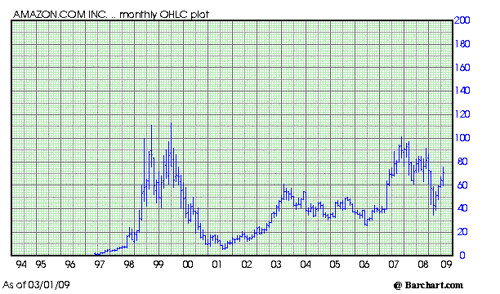
Amazon (AMZN), Ten Year Chart, Monthly.

In May, 1997 Amazon (AMZN) was labeled Amazon.toast and Amazon.bomb by Forrester Research and Barron's. Since then it has risen more than 5,000 percent.

Amazon Chart Ten Year 328Align Center

Highlights:
  • Amazon was founded in 1994, and went public in 1997.
  • In 1997, Amazon was labeled Amazon.toast and Amazon.bomb by Forrester Research and Barron's.
  • By 1999, cumulative losses at Amazon exceeded $550 million.
  • In December, 1999, Jeff Bezos was chosen as Time magazine's person of the year (see Cover).
  • In December 1999, Amazon reached its highest raw price in history at $113 a share.
  • In the summer of 2000, an analyst at Lehman Brothers warned investors that the company might run out of cash and advised them to avoid its stock.
  • In September 2001, Amazon dropped to its lowest raw price in history--$5.67 a share.
  • In October, 2007 Amazon traded over $100 a share for the third time, and the first time since 1999.
  • The split adjusted price of Amazon dating back to 1997 is $1.31 a share.
  • On March 23, 2009 Amazon closed at $75.61 a share, its highest price since falling to $34.68 a share in November, 2008.
  • Amazon is currently up more than 50 times its adjusted initial public offering price, or 5,700 percent.

A month after Jeff Bezos' was named Time's person of the year, the company fired 150 workers as part of an internal reorganization. Just five days later, Amazon reported a loss of $323 million for the holiday fourth quarter and promised that future losses would be lower. (The company, however, would later exceed that amount by more than $200 million).

Follow All American Investor on Twitter
Subscribe to All American Investor via Email

Friday, March 13, 2009

Housing Bargains Galore--Glass Half Full or Half Empty?


You know the saying, glass half full, glass half empty. In today's housing world it depends whether you are a buyer or seller. Buyer good, seller bad. Take a look at this,


In Henderson, Nev., a homeowner is trying to sell the house above for $149,999 -- less than the mortgage – two years after Pulte Homes built it. Ben Prasad of Realty Professionals of LV is the listing broker on the house. Meanwhile, Pulte is offering a similar house nearby, below, for $214,990.

The house in the picture looks like a bargain to me at $149,999. $125,000 bid?
Subscribe to EF Hutton via Email

Foreclosed Houses Haunt Home Builders

By MICHAEL CORKERY and DAWN WOTAPKA

(See Correction & Amplification below.)

As the normally hot spring selling season begins, two houses in the Inland Empire region of Southern California sum up the big problem facing many of the nation's largest home builders.

One of the houses, a four bedroom built in 2006 that was seized by a lender in a foreclosure action, is listed for sale at $229,900. Meanwhile, in the same housing development, D.R. Horton Inc. is trying to sell a new house that looks nearly identical for $299,000, or 23% more.

Or consider Pulte Homes Inc.'s predicament in Henderson, Nev., near Las Vegas. The builder is trying to sell a new, four-bedroom house for $214,990, while a home owner is trying to dump a similar house, which Pulte built two years ago, for $149,999. That price is less than the owner's mortgage under a "short sale" approved by the lender.

In many markets, "we are no longer competing with other builders. We are competing with foreclosures," said Steve Ruffner, president of the Southern California division of KB Home.

Sales of used homes are actually rising in some regions because of foreclosures, but new-home sales fell to a four-decade low in January, down 77% from their peak in summer 2005. Altogether, home builders sold houses at a seasonally adjusted annual rate of 309,000 units in January, down from a peak of 1.4 million in July 2005.

Home builders are confronting the competition from foreclosures at a difficult time in their history. Small builders are dying by the dozens, while some large companies are staying afloat by cutting expenses and scrambling to restructure debt.

President Barack Obama's foreclosure-prevention plan is likely to help stem the supply of bank-owned houses somewhat, and the administration's proposed budget would extend builders a lifeline through a lucrative tax break. But the foreclosure problem won't disappear.

In Henderson, Nev., a homeowner is trying to sell the house above for $149,999 -- less than the mortgage – two years after Pulte Homes built it. Ben Prasad of Realty Professionals of LV is the listing broker on the house. Meanwhile, Pulte is offering a similar house nearby, below, for $214,990.

"I don't know how the builders are going to compete," said Credit Suisse analyst Daniel Oppenheim, who downgraded his ratings for Centex Corp. and D.R. Horton stock last week, partly out of concern about foreclosure competition.

The problem is particularly vexing because many buyers are bypassing new houses for foreclosed ones that are virtually new and are often located in the companies' own developments. "Buyers think they are going to get the best bargain with a foreclosed house, and they aren't even looking at new homes," said Graham Holmes, owner of Reviron Realty, which sells bank-owned properties in the Inland Empire.

Home builders' responses to the foreclosure threat vary. Los Angeles-based KB Home is focusing on building smaller, lower-priced houses that can compete with foreclosures head on. The builder has shrunk its house size from an average of 3,200 square feet during the housing boom to an average of 1,600 square feet in many markets today. "We're finding that if we can get a product to market that is priced competitively with foreclosures, [we] can sell pretty well, even in these times," said Jeffrey Mezger, KB's chief executive.

Dallas-based Centex, on the other hand, says it's not trying to beat lenders on price. Instead, the nation's third largest builder by volume is trying to entice buyers with perks like mortgage interest rates as low as 4.25%, energy-efficient designs and warranties.

D.R. Horton also offers incentives, including covering the buyer's closing costs, and touts a $10,000 California tax credit for buying a new house. And it notes that buyers often need to spend money to fix up foreclosed properties before they can move in.

Builders also argue that while they may look alike, new and foreclosed houses aren't comparable. "Our brand-new homes appeal to the buyer who wants up-to-date features, a chance to make their own selections like carpeting and paint colors," a Pulte spokesman said.

Some buyers clearly agree. "A foreclosure is like a used car," said Danny Hernandez, who bought a new, $237,000, five-bedroom KB house in Beaumont, Calif., in the hard-hit Inland Empire. Mr. Hernandez, a 41-year-old warehouse worker, said the fact KB paid his closing costs and a nonprofit group subsidized his down payment helped make the sale.

Another strategy: build in new neighborhoods that aren't filled with vacant, bank-owned houses. "In general, we try not to compete with foreclosures," said Centex Chief Executive Tim Eller. "It's not all about price, it's about value. Buyers determine value by the look and feel of the neighborhood."

KB said its smaller houses are selling well, but the prices keep sinking. In November, KB was selling its line of smaller houses at a development in Beaumont for as little as $207,990. Now, it has dropped its starting price to $169,990 to match recent foreclosure values in Beaumont. Since it opened the Highland Vista development last summer, KB has sold 28 homes out of about 110 house lots.

Analysts question how low builders can go before building a house costs more than they can charge for it. In some markets in California and Florida, builders have reached that point and have stopped building.

Write to Michael Corkery at michael.corkery@wsj.com and Dawn Wotapka at dawn.wotapka@dowjones.com

Corrections & Amplifications

D.R. Horton is trying to sell a new, four-bedroom house in the Inland Empire region of California for $299,000, or about 30% more than an identical-looking, nearby foreclosed house, which is listed for $229,900. This article incorrectly said it was 23% more.


Bob DeMarco is a citizen journalist and twenty year Wall Street veteran. Bob has written more than 500 articles with more than 11,000 links to his work on the Internet. Content from All American Investor has been syndicated on Reuters, the Wall Street Journal, Fox News, Pluck, Blog Critics, and a growing list of newspaper websites. Bob is actively seeking syndication and writing assignments.


Follow E F Hutton on Twitter