Showing posts with label inflation. Show all posts

Thursday, April 30, 2009

Fed Monetizing Debt -- How long before the Inflation Comes?


No matter how you cut or slice it, the FED is going to monetize debt. This means you want to be owning stocks and ETFs that benefit from an increase in inflation.

Over the next week, we will be putting up some of our ideas on how to take advantage of this scenario.

If you have been following the charts on All American Investor -- you noticed that I have been talking about rising rates in the ten and thirty year treasuries for a few weeks. If you are not paying close attention to this as in investor you are making a big mistake.

The bond vigilantes are coming back, and soon with a vengeance. Longer dated treasury interest rates are drifting up. This, in spite, of massive buying of treasuries by the FED -- we showed the balance sheet on Saturday.

Here is a snippet from the latest FOMC release:

As previously announced, to provide support to mortgage lending and housing markets and to improve overall conditions in private credit markets, the Federal Reserve will purchase a total of up to $1.25 trillion of agency mortgage-backed securities and up to $200 billion of agency debt by the end of the year. In addition, the Federal Reserve will buy up to $300 billion of Treasury securities by autumn. The Committee will continue to evaluate the timing and overall amounts of its purchases of securities in light of the evolving economic outlook and conditions in financial markets. The Federal Reserve is facilitating the extension of credit to households and businesses and supporting the functioning of financial markets through a range of liquidity programs. The Committee will continue to carefully monitor the size and composition of the Federal Reserve's balance sheet in light of financial and economic developments.

Buy $300 billion of treasuries by Autumn?

The best way to think of the current scenario is like boiling water in a tea pot. Sooner or later, the whistle will blow.

Don't like the above? Remember, I am the same guy that predicted this really in stocks when I wrote:
  • They call me crazy -- S and P 900-1000
  • and, Stocks Don't Fight the Tape.
There is a lot of chicken on the hill. My guess here right now is: material stocks, commodity stocks, related ETFs and short the long bond.
Subscribe to All American Investor via Email

Sunday, April 19, 2009

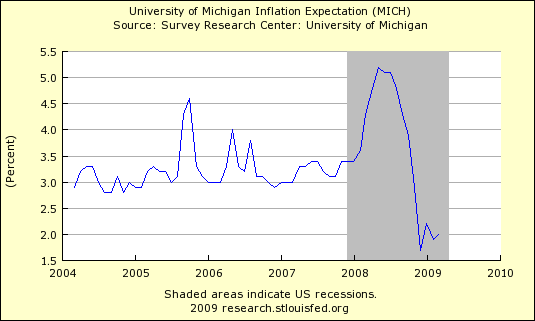
Inflation Expectation, Gasoline and Hershey Bar Up (Graph)


The University of Michigan’s latest reading of consumer sentiment showed expectations for inflation over the next year rising in April to 3%, from 2% in March. This is likely due to the recent rise in gasoline prices and the recent large increase in the price of the eight ounce hershey bar.

I don't know about you, but when I come out of the grocery store after spending 30 bucks one of two things is happening:
  • I am getting a lot stronger
  • Or, the bags are a lot lighter.
There is a third alternative. The bags weight the same, and I spent 40 bucks.

I learned a long time ago that trends are slow to develop. It will take a while for inflation to gain some momentum on the upside. This means it takes some time for large rises in the monetary base and in the Fed's balance sheet to take effect.

The chart below is updated through March due to a data embargo. So you will have to use your imagination and add in April's three percent number.

University of Michigan Inflation Expectation 418
Subscribe to All American Investor via Email
Kindle 2: Amazon's New Wireless Reading Device (Latest Generation)


Follow All American Investor on Twitter

Saturday, April 04, 2009

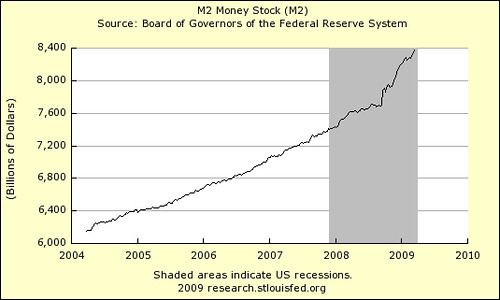
M2, Money Supply Continues to Soar


M2, Money Stock

M@ Money Stock 327Align Center


Money Supply as measured by M2 continues to soar. Does anybody really care?

Back in the early 1980s if M2 started rising, the bond vigilantes would have been out in force pushing interest rates higher. Now, not a "peep".

One can only wonder how long it is going to take for this surge in money to take effect. Commodities are at rock bottom as I am writing this.

One thing for sure, if the Fed has acted as it did in the 1930s we would all be eating rocks by now. Potato anyone?

Stay tuned, the fun is going to start very soon.

M2 includes a broader set of financial assets held principally by households. M2 consists of M1 plus:
(1) savings deposits (which include money market deposit accounts, or MMDAs);
(2) small-denomination time deposits (time deposits in amounts of lessthan $100,000);
and (3) balances in retail money market mutual funds(MMMFs).
Seasonally adjusted M2 is computed by summing savings deposits, small-denomination time deposits, and retail MMMFs, each seasonally adjusted separately, and adding this result to seasonally
adjusted M1.
Subscribe to All American Investor via Email

Monday, March 09, 2009

Buffett Inflation has the "potential" to be worse than the 1970s


He added that inflation “has the potential” to be worse than the double-digit rates of the 1970s. “It depends on the wisdom of our policies, what we do with” new government spending. Buffett said that Republicans need to stand behind the Obama administration, but Obama and Democrats should not use the crisis “to roll Republicans.”
Other highlights:
  • The economy "can't turn around on a dime" and a turnaround "won't happen fast."
  • Five years from now, the economy will be running fine. The strength of the American system will pull it through, just as it has many times in the past.
  • Democrats and Republicans should work together and not try to take advantage of the economic situation to achieve partisan goals.
  • Inflation has the "potential" to be worse than the 1970s.
  • Most banks are in "pretty good shape" and can "earn their way out" of the current problems given the low cost of funds. Banks, however, "need to get back to banking."
  • Extremely important that the government make clear depositors won't lose their money if banks fail. Obama needs to make a "clear statement" in support of the banking system.
  • Berkshire is restricted from buying more American Express stock, but that doesn't mean it is not a "hell of a buy" at $10 a share.
  • Wishes he had written the New York Times "Buy American" piece a few months later, but stands by the basic argument that you'll do better over a ten-year period with stocks that you will with Treasuries. He said in the article he wasn't calling the bottom of the stock market, and he still isn't.
  • Buffett says derivatives are not "evil" and to be avoided at all costs, but they are "dangerous" and should be used very carefully. He still expects to make money on the long-term "put option" equity derivative contracts Berkshire has written. 
  • Housing market could work through, or "sop up," its excess supply in as little as three years if new construction is reduced to a level below natural population growth
  • The U.S. economy was not a "house of cards" over the past ten years, but mistakes were made when it came to borrowing money.
  • Mark-to-market accounting should be retained, but regulators shouldn't use it so much to require insitutions to increase their reserves.
  • "Probably the uptick rule" is a good idea.
  • Mistake to "demonize" corporate executives for using private jets. Having a jet has helped Berkshire make deals in the past.
  • Praises Ben Bernanke's leadership as Federal Reserve Chairman.

Warren Buffett to CNBC: Economy Has "Fallen Off a Cliff"

Subscribe to EF Hutton via Email

Bob DeMarco is a citizen journalist, blogger, and Caregiver. In addition to being an experienced writer he taught at the University of Georgia , was an Asociate Director and Limited Partner at Bear Stearns, was CEO of IP Group, and is a mentor. Bob currently resides in Delray Beach, FL where he cares for his mother, Dorothy, who suffers from Alzheimer's disease. Bob has written more than 500 articles with more than 11,000 links to his work on the Internet. His content has been syndicated on Reuters, the Wall Street Journal, Fox News, Pluck, BlogCritics, and a growing list of newspaper websites (15). Bob is actively seeking syndication and writing assignments.

Federal Reserve Bank Balance Sheet Exploding (includes Chart)


The chart below from the St Louis Fed is disturbing. The chart depicts the Balance Sheet of the Federal Reserve Bank. As you can see the balance sheet has soared since mid-September 2008. This rise is unprecedented and was caused by the financial situation beginning with Bear Stears, Lehman, and AIG.


The Fed now owns $27.0 Billion of poor quality assets from the troubles at Bear Stearns. It owns another $46.7 Billion from AIG. In addition, The FRB now owns $316.2 Billion in a Commercial Paper Funding Facility; and, $465 Billion in Central bank liquidity swaps. Prior to this crisis both of the last two number were zero. Next, the Fed is being instructed to start buying mortgage backed securities from distressed banks. This will balloon the monetary base once again.
Subscribe to EF Hutton via Email
The U.S. monetary base has increased from approximately $890 billion to $1,740 billion--doubling in a little more than 3 months. This is unprecedented and is represented by the blue line climbing straight up the right side of the chart.

Right now, there is little concern about inflation. However, there should be concern because if markets do not become normalized soon, the Fed will not be able to sell these distressed assets without taking enormous losses. If the Fed is unable to unwind these assets in an orderly fashion then inflation will almost certainly come back with a vengeance.

Gold, oil, and commodity prices should be watched very closely by investors. Even a slight pick up in demand is likely to send commodity price up sharply. Weather factors could also be a factor in the major growing regions of the United States this year--right now it is very dry, not a good condition.

Rises in the monetary base often lead to rises in inflation. The current increase in the monetary base started in the later part of 2007; and then took off with a vengeance in September 2008. There is usually a 12-18 month lag before inflation hits. We are coming into the window right now.

Bob DeMarco is a citizen journalist, blogger, and Caregiver. In addition to being an experienced writer he taught at the University of Georgia , was an Associate Director and Limited Partner at Bear Stearns, was CEO of IP Group, and is a mentor. Bob currently resides in Delray Beach, FL where he cares for his mother, Dorothy, who suffers from Alzheimer's disease. Bob has written more than 500 articles with more than 11,000 links to his work on the Internet. His content has been syndicated on Reuters, the Wall Street Journal, Fox News, Pluck, Blog Critics, and a growing list of newspaper websites. Bob is actively seeking syndication and writing assignments.


Sunday, January 11, 2009

PIMCOs Gross likes Muni Bonds and Treasury Inflation Protected Securities


Municipal bonds are among the best buying opportunities now as states line up for billions in federal aid from the incoming Barack Obama administration, said Bill Gross, chief investment officer of the giant bond firm PIMCO.

Other strategies offered by Gross in his January investment newsletter were buying Treasury Inflation Protected Securities (TIPS) and certain investment-grade corporate bonds.

By contrast, in the Treasury market, "low yields offer little reward and increasing risk," given ballooning federal budget deficits, he said.

Subscribe to EF Hutton via Email


PIMCO's Gross says muni bonds and TIPS "attractive"


By Ros Krasny

CHICAGO (Reuters) - Municipal bonds are among the best buying opportunities now as states line up for billions in federal aid from the incoming Barack Obama administration, said Bill Gross, chief investment officer of the giant bond firm PIMCO.

Other strategies offered by Gross in his January investment newsletter were buying Treasury Inflation Protected Securities (TIPS) and certain investment-grade corporate bonds.

By contrast, in the Treasury market, "low yields offer little reward and increasing risk," given ballooning federal budget deficits, he said.

Gross noted that requests for aid from municipalities and states total nearly $1 trillion "and to think California or New York City would be allowed to fail is, well -- unthinkable."

"Municipal bonds ... selling at historically high ratios relative to U.S. Treasuries, offer attractive price appreciation potential, or at the very least a defensiveness with high carry that a 2 1/2 percent 10-year Treasury cannot," Gross said.

According to Municipal Market Data, top-rated 30-year munis now yield 161 percent and 10-year munis yield 133 percent of comparable Treasuries.

Triple A rated munis started 2008 yielding a more normal 85 percent of 30-year Treasuries and 79 percent of 10-year government bonds.

Meanwhile, Gross said he doubted the U.S. economy was in for the type of deflation that markets are forecasting, making TIPS a good buy.

Current ultra-low Treasury yields "cannot possibly be maintained unless deflation, as opposed to inflation, becomes the odds-on favorite," he said.

Market-based break-even inflation rates now point to a consumer price index averaging negative 1 percent for the next 10 years, which Gross termed "possible, but not likely."

On the corporate bond side, yields of 6 percent or more for intermediate maturities are still common, Gross said.

"Investors should recognize the value of high-quality, investment-grade corporate bonds in many markets."

Otherwise, PIMCO continues to maintain a strategy of buying assets that are under the federal bailout "umbrella."

"Shake hands with the government ... their checkbook represents the largest and most potent source of buying power in 2009 and beyond," Gross said.

Gross said investors needed to be vigilant about higher inflation over the long term, given the "near certainty of future budget deficits approaching 6 percent to 7 percent of GDP."

(Additional reporting by Karen Pierog; Editing by Kenneth Barry)

Tuesday, December 30, 2008

Nikkei Up on Last Session of 2008, Logs Worst Year Ever


Japan's Nikkei 225 Average fell 42 percent in 2008, the worst loss in its 58-year history, though the benchmark gained 1.3 percent on its final half-day of trade.

Its annual losses were the worst ever, surpassing the 38.7 percent tumble marked in 1990.
Subscribe to EF Hutton via Email

Follow EF Hutton on Twitter


Nikkei Up on Last Session of 2008, Logs Worst Year Ever

Japan's Nikkei 225 Average fell 42 percent in 2008, the worst loss in its 58-year history, though the benchmark gained 1.3 percent on its final half-day of trade.

Canon and other exporters gained as the dollar rose slightly against the yen before falling back, while oil and gas field developer Inpex climbed as oil extended gains on concern that Israeli attacks on Gaza could disrupt Middle East crude oil supplies.

Toyota Motor bucked the trend by slipping 1 percent, badly hit like the rest of the auto sector -- one of the Tokyo market's worst performing sectors this year -- by the worsening global economy. The Nikkei gained 112.39 points on Tuesday and rose 4
percent for December, its first positive month since May. But its annual losses were the worst ever, surpassing the 38.7 percent tumble marked in 1990.

The broader Topix index gained 0.5 percent on Tuesday to 859.24 but was also down 42 percent for the year. Trade will resume on Jan 5.

Market players forecast a tough 2009 but said that hopes of further economic stimulus packages to stem the worsening of the global economy were providing some lift.

"Everyone's pinning their hopes on economic stimulus policies by the United States and possibly China, which is keeping the market supported for now," said Tomomi Yamashita, a fund manager at Shinkin Asset Management.

"But people aren't watching things like company results as closely as they should be. We can't say for sure that the market's bottomed out until we see these next spring."

In one possible sign of things to come, shares of Sharp edged down 0.3 percent to 636 yen after the Nikkei business daily said the consumer electronics maker will book an extraordinary loss of more than 50 billion yen ($555 million) for the year to March 31, largely due to an impairment loss on its stake in Pioneer.

But other market players said the worst was likely over.

"The main problems in the United States are being tackled one by one, meaning a lot of uncertainties are being removed," said Hideyuki Ishiguro, a supervisor in the investment strategy division at Okasan Securities.

"The market has also factored in the various company losses this quarter and the gloomy predictions for next quarter, so these alone are unlikely to send it to new lows."

The U.S. government said on Monday it was pumping $5 billion into auto and mortgage lender GMAC LLC and lending up to $1 billion to automaker General Motors, ensuring the solvency of a company considered crucial to GM's survival and providing some marginal support to Tokyo shares.

Resources Shares Climb, Exporters Up

Oil prices rose after surging more than $2 on Monday amid concern that Israeli attacks on Gaza, which continued on Tuesday as Israeli aircraft fired missiles at government buildings in the Gaza Strip, could disrupt Middle East crude oil supplies.

More From CNBC.com
# Get After-the-Bell Dow 30 Quotes
# Credit Spreads and Libor Data
# Futures and Pre-Market Data
# Currency Data

Resource-linked shares such as Mitsubishi Corp and other trading houses climbed as a result.

Mitsubishi Corp, Japan's largest trading house, rose 2.8 percent to 1,238 yen and fellow trader Mitsui & Co gained 3 percent to 901 yen. Itochu Corp gained 1.8 percent to 443 yen. Oil and gas field developer Inpex surged 5.1 percent to 698,000 yen.

Blue-chip exporters rose as well, with Sony gaining 1.2 percent to 1,922 yen and Canon rising 2.8 percent to 2,770 yen.

But Toyota slipped 1 percent to 2,905 yen, though fellow automakers Honda Motor and Nissan Motor both rose.

Trade picked up on the Tokyo exchange's first section, with 854 million shares changing hands, compared with last week's morning average of 597 million. Advancing stocks outpaced declining ones by nearly 3 to 1.
Copyright 2008 Reuters. Click for restrictions.

URL: http://www.cnbc.com/id/28429197/

Friday, March 30, 2007

Stagflation on the Horizon?


The Fed could soon be facing both accelerating inflation and a slowing economy. And, this is my expectation.

Real disposable incomes (inflation-adjusted and after taxes) increased 0.1%, matching December with the lowest in nine months. A puny gain for sure and a possible sign that it could be negative next month. A sign of Stagflation?

Real (inflation-adjusted) consumer spending growth slowed to 0.2%, the weakest gain since August. Spending had risen 0.3% in January. Another potential bad sign.

Did you know you can receive the CNBC Portfolio Challenge Bonus Bucks Answers via email by subscribing to this blog?

Subscribe to Robert T DeMarco Weblog by Email