Showing posts with label fed. Show all posts

Tuesday, October 06, 2009

How the Federal Reserve Can Avoid the Next Bubble


The central bank needs to watch asset prices and raise rates quickly when it decides the time is right.

From the Wall Street Journal

By IAN BREMMER AND NOURIEL ROUBINI

Ben Bernanke and the Federal Reserve face a number of very difficult challenges in the years ahead. They include:

• Resisting pressure to monetize deficits, which would eventually cause high inflation.

• Implementing an exit strategy from the massive monetary easing of the past year.

• Maintaining the Fed's independence, which has been compromised by the direct and indirect bailout of financial institutions and congressional attempts to micromanage the central bank.

• Properly calculating asset prices and the risk of asset bubbles according to the Taylor rule, an important guideline central banks use to set interest rates.

• Supervising and regulating the financial system more effectively, particularly in the role of "systemic risk" regulator.


The first two tasks are closely related. In order to prevent a persistent monetization of deficits that would lead to inflation, the Fed must implement an exit strategy from the unconventional monetary easing that began in late 2008. If the fiscal and monetary stimulus is taken away too soon, there is the risk of relapsing into deflation. If it is taken away too late, we may eventually face a fiscal crisis and an inflationary recession, or stagflation.

The Fed does not control fiscal policy. But to avoid a game of chicken wherein loose fiscal policy forces the Fed to monetize deficits to prevent a spike in bond yields, the Fed needs to pre-emptively state it won't be buying more Treasury bills.

As for the exit from monetary easing, the Fed must learn from the fateful mistake it made after the 2001 recession. Then, the central bank cut the federal-funds rate too much and kept it too low for too long. It also moved far too slowly when the normalization occurred—in small increments of 0.25% from summer 2004 until the summer of 2006, when it peaked at 5.25%. Normalization took two full years. It was in that period of slow normalization that the housing, mortgage and credit bubbles spiraled out of control. The lesson learned: When you normalize, move rapidly, or prepare for another dangerous bubble.

Of course, this is easier said than done. From 2002 to 2006, the Fed moved slowly because the recovery appeared anemic and because of significant deflationary pressures. This time around, the recession is more severe—unemployment is at 9.8% and is expected to peak above 10%, and we are experiencing actual deflation. Therefore, the incentive not to exit too soon will be greater and the risk of creating another bubble is greater. Indeed, the sharp increase in the stock market and commodities, and narrowing of credit spreads since March, are partly due to a wall of global liquidity chasing assets and already causing asset inflation.

If the conflict between economic growth and financial stability requires that monetary policy remain loose, then it is critical that the supervisors and regulators of the banking sector move aggressively to prevent another bubble from emerging. Thus they should quickly adopt the regulatory reforms agreed to by the G-20—including a new insolvency regime for financial institutions deemed "too big to fail," a serious approach to limiting "systemic risk," and appropriate rules governing incentives and compensation for bankers and traders.

It won't be easy to define systemic regulation and too-big-to-fail. There is a significant risk that doing so will provide an implicit guarantee for large and complex financial institutions. There is also a longer-term risk that actions taken by congressional and regulatory agencies will distort global financial markets. Western financial institutions now depend heavily on state financial backing, and several governments have tweaked rules and regulations to support the large financial institutions that are now at least partially taxpayer-owned. Further, governments could increasingly require domestic financial institutions to lend more at home, which will curtail their foreign operations. Creating a system of effective financial regulation—while resisting the impulse to favor domestic institutions—will be a real challenge for most countries, including the U.S.

Over time, once the fed-funds rate is normalized, incorporating asset prices into monetary policy making is also necessary to ensure financial stability. While it is correct that the fed-funds rates may not be the most effective instrument at controlling asset and credit bubbles, excessively cheap money is always a source of such bubbles. So faster normalization of the fed-funds rate will eventually be important.

The Fed's involvement in quasi-fiscal operations creates other challenges. As long as the Fed remains involved in maintaining financial stability and in preventing other episodes of systemic risk, it will be hard to eliminate the perception that the Fed will be involved as a lender of last resort for too-big-to-fail firms. So far, this Pandora's Box remains open.

The way to prevent future moral-hazard distortions is to create a regulatory regime where too-big-to-fail institutions have much higher capital requirements: a greater liquidity buffer, lower leverage, and lower involvement in risky and illiquid investments if they are depository banks. They should be supervised internationally and must be able to be closed down in an orderly fashion should failure loom.

The Fed is currently resisting a Treasury-led effort to review how it is organized out of concern it might forfeit its independence. Yet the governance structure of the New York and other regional Federal Reserve banks left them effectively controlled by large financial institutions last year, so such a review is necessary. While congressional interference in the Fed's jurisdiction is a danger, the recent quasi-fiscal activities of the Fed bear a review.

The Fed also needs a greater regulatory backbone. The Fed had the power to regulate mortgage markets but failed to use this power out of a misplaced deference to laissez-faire attitudes and Wall Street. Regulating mortgage markets requires a careful balance: short-term regulatory forbearance to avoid a greater credit crunch, along with medium-term countercyclical supervisory actions in order to prevent the emergence of further asset and credit bubbles.

Establishing financial stability—in addition to price stability and growth—is the essential role of the central bank. Achieving this goal in a way that avoids moral-hazard distortions, as with the too-big-to-fail finance institutions, and prevents another bubble in the next years will surely be one of the greatest challenges ever faced by the Fed.

Mr. Bremmer, president of Eurasia Group, is co-author of the "The Fat Tail: The Power of Political Knowledge for Strategic Investing" (Oxford University Press, 2009). Mr. Roubini is a professor of economics at New York University's Stern School of Business and chairman of RGE Monitor.

Kindle: Amazon's 6" Wireless Reading Device

Tuesday, June 16, 2009

Mortgage Rates Blast Off (Graph)


The negative implications of the sharp rise in mortgage interest rates are to many to list. When interest rates rise house get more expensive. This is likely to slow the economic recovery in housing -- a real negative. Another likely outcome is the end of the refinancing boom.

Let's not forget, the Treasury has been in the markets buying Treasury securities and mortgage backed securities. As we have pointed out for many months, the Treasury balance sheet is exploding with no end in sight. Rates continue to rise against this background.

It should be clear that there is little or nothing that the FED and Treasury can do to stem the rise in longer dated securities.

Here is another little noticed fact that we will be writing about soon. Since June 1, the two year treasury has risen 26 basis points, while the ten year treasury has dropped 4 basis points. This means the yield curve is flattening. Go here for the Daily Treasury Yield Curve Rates.

My guess is in the next 12-18 months the market will realize that stagflation is the name of the game.

This is the worst thing that can happen to the dollar. The only thing that could stem a run on the dollar is FED tightening.
Subscribe to EF Hutton via Email


Bob DeMarco is a citizen journalist and twenty year Wall Street veteran. Bob has written more than 500 articles with more than 11,000 links to his work on the Internet. Content from All American Investor has been syndicated on Reuters, the Wall Street Journal, Fox News, Pluck, Blog Critics, and a growing list of newspaper websites. Bob is actively seeking syndication and writing assignments.


Follow E F Hutton on Twitter

Kindle: Amazon's 6" Wireless Reading Device

Saturday, June 13, 2009

FED Loans to AIG for Credit Default Swaps (Maiden Lane III, Graph)


On November 25, 2008, the Federal Reserve Bank of New York began extending credit to Maiden Lane III LLC.

This limited liability company was formed to purchase multi-sector collateralized debt obligations (CDOs) on which the Financial Products group of American International Group, Inc (AIG) had written credit default swap (CDS) contracts.

Net portfolio holding of Maiden Lane III at peak $28.085 billion (December 24, 2008). Current holding $19.876 billion.

FED continuing to assume risks of these credit default swap transactions.

Subscribe to EF Hutton via Email


Kindle: Amazon's 6" Wireless Reading Device

Saturday, June 06, 2009

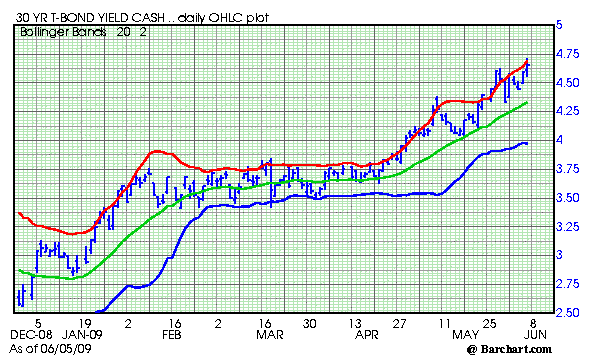
30 Year Bond Inflation Vigilantes in the Driver Seat (Graph)


30 Year Bond Infaltion Vigilantes Take Over (Graph)

If you were around during the 1980s you know all about the bond vigilantes. When inflation is on the horizon they take over in the long end of the Treasury market.

The 30 year chart above shows that institutional investors are worried about the current policies of the Federal Reserve and Treasury. When this occurs, a interest rate risk premium gets built into the bond. In other words, investors want a bigger cushion to accept the risk of investing in long term Treasury Bonds.

These interest rates look high in comparison to recent history. However, if you are old enough you will remember when the long bond traded above 15 percent. Right now, if you told someone you believed that could happen again, they would tell you -- you are nuts.

They told me I was nuts when I wrote about fire not smoke, when the S and P 500 was in the 1250 area. Nobody thought we could see the stock market fall in half from those levels.

Over the next few years, talk about a downgrade of U.S. debt is going to increase. It appears right now that the downgrade is inevitable. However, it is probably two to four years in the future. The market will discount the downgrade before it happens.

Expect 30 year Treasury bond yields to continue to rise for the foreseeable future. Constant Treasury intervention to try and hold down long term interest rates will fail.

Remember when the Treasury intervened in the Gold market over and over to try and hold prices down?
Subscribe to EF Hutton via Email


Bob DeMarco is a citizen journalist and twenty year Wall Street veteran. Bob has written more than 500 articles with more than 11,000 links to his work on the Internet. Content from All American Investor has been syndicated on Reuters, the Wall Street Journal, Fox News, Pluck, Blog Critics, and a growing list of newspaper websites. Bob is actively seeking syndication and writing assignments.


Follow E F Hutton on Twitter

Kindle: Amazon's 6" Wireless Reading Device

Sunday, May 24, 2009

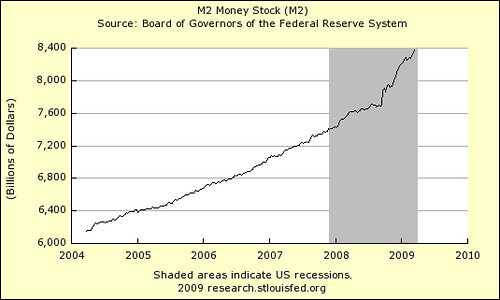
Fed Series M2, Money Supply Still Soaring (Chart)


Fed Data, M2, Money Stock, Chart


We wrote several months ago about how it takes 12-18 months for increases in money supply to effect interest rates and commodity prices. We are now in this window.

The dramatic increases in money supply, the Fed balance sheet, and the drop in the dollar are starting to weigh on investor confidence.

Stocks rarely rise when confidence dwindles. It now seems we are moving from what was growing confidence in the markets to growing uncertainty.

The risk of owning equities on a short term basis not outweighs the reward. The threat of rising interest rates has also risen dramatically. This weeks surge in Gold is another barometer of investor confidence.
Subscribe to EF Hutton via Email

Bob DeMarco is a citizen journalist and twenty year Wall Street veteran. Bob has written more than 500 articles with more than 11,000 links to his work on the Internet. Content from E F Hutton has been syndicated on Reuters, the Wall Street Journal, Fox News, Pluck, Blog Critics, and a growing list of newspaper websites. Bob is actively seeking syndication and writing assignments.


Follow E F Hutton on Twitter

Kindle: Amazon's Wireless Reading Device (Latest Generation)

Thursday, April 30, 2009

Fed Monetizing Debt -- How long before the Inflation Comes?


No matter how you cut or slice it, the FED is going to monetize debt. This means you want to be owning stocks and ETFs that benefit from an increase in inflation.

Over the next week, we will be putting up some of our ideas on how to take advantage of this scenario.

If you have been following the charts on All American Investor -- you noticed that I have been talking about rising rates in the ten and thirty year treasuries for a few weeks. If you are not paying close attention to this as in investor you are making a big mistake.

The bond vigilantes are coming back, and soon with a vengeance. Longer dated treasury interest rates are drifting up. This, in spite, of massive buying of treasuries by the FED -- we showed the balance sheet on Saturday.

Here is a snippet from the latest FOMC release:

As previously announced, to provide support to mortgage lending and housing markets and to improve overall conditions in private credit markets, the Federal Reserve will purchase a total of up to $1.25 trillion of agency mortgage-backed securities and up to $200 billion of agency debt by the end of the year. In addition, the Federal Reserve will buy up to $300 billion of Treasury securities by autumn. The Committee will continue to evaluate the timing and overall amounts of its purchases of securities in light of the evolving economic outlook and conditions in financial markets. The Federal Reserve is facilitating the extension of credit to households and businesses and supporting the functioning of financial markets through a range of liquidity programs. The Committee will continue to carefully monitor the size and composition of the Federal Reserve's balance sheet in light of financial and economic developments.

Buy $300 billion of treasuries by Autumn?

The best way to think of the current scenario is like boiling water in a tea pot. Sooner or later, the whistle will blow.

Don't like the above? Remember, I am the same guy that predicted this really in stocks when I wrote:
  • They call me crazy -- S and P 900-1000
  • and, Stocks Don't Fight the Tape.
There is a lot of chicken on the hill. My guess here right now is: material stocks, commodity stocks, related ETFs and short the long bond.
Subscribe to All American Investor via Email

Saturday, April 04, 2009

M2, Money Supply Continues to Soar


M2, Money Stock

M@ Money Stock 327Align Center


Money Supply as measured by M2 continues to soar. Does anybody really care?

Back in the early 1980s if M2 started rising, the bond vigilantes would have been out in force pushing interest rates higher. Now, not a "peep".

One can only wonder how long it is going to take for this surge in money to take effect. Commodities are at rock bottom as I am writing this.

One thing for sure, if the Fed has acted as it did in the 1930s we would all be eating rocks by now. Potato anyone?

Stay tuned, the fun is going to start very soon.

M2 includes a broader set of financial assets held principally by households. M2 consists of M1 plus:
(1) savings deposits (which include money market deposit accounts, or MMDAs);
(2) small-denomination time deposits (time deposits in amounts of lessthan $100,000);
and (3) balances in retail money market mutual funds(MMMFs).
Seasonally adjusted M2 is computed by summing savings deposits, small-denomination time deposits, and retail MMMFs, each seasonally adjusted separately, and adding this result to seasonally
adjusted M1.
Subscribe to All American Investor via Email

Tuesday, January 27, 2009

Will the Commercial Paper Market get Tested on Friday?


The Fed launched the Commercial Paper Funding Facility on Oct. 27 to buy short-term debt directly from companies amid the credit market's seizure. Now, the Fed holds about $350 billion of commercial paper in the facility. That is close to 21% of the $1.7 trillion market. About $230 billion of this debt is set to mature by Friday.
The question: Will companies like General Electric or GMAC, which issue this short-term debt to pay their bills and meet other near-term obligations, return to the open market rather than roll over their debt with the central bank.
With the market looking on two additional question will be answered:
  • Is the open market capable and willing to fund these companies?
  • If they return to the open market what will be the cost of funding their obligations?
This could result in an interesting test of the commercial paper market. It will also be an interesting test of the bailout. A good result might help stabilize the stock market. A bad result? We shall see.
Subscribe to EF Hutton via Email


Fed Program That Calmed Debt Market Faces a Test


By LIZ RAPPAPORT

This week brings one of the first tests of success for a key Federal Reserve program that has calmed the short-term credit markets.

About $230 billion of three-month debt that the Fed owns, in the form of commercial paper, is set to mature by Friday.

The questions are: Will companies like General Electric or GMAC, which issue this short-term debt to pay their bills and meet other near-term obligations, return to the open market rather than roll over their debt with the central bank, which costs a lot more? Can the still-fragile market absorb so much three-month debt in a single week without sending interest rates much higher? And is the Fed winding down this key program?

The Fed launched the Commercial Paper Funding Facility on Oct. 27 to buy short-term debt directly from companies amid the credit market's seizure, following Lehman Brothers' collapse.

At the time, money-market funds, which are the main buyers of this debt, were hoarding cash to meet redemptions and companies couldn't obtain loans for much more than 24 hours, and at rates as high as 7% or more.

GMAC says it is evaluating all of its funding options, while General Electric Chief Executive Jeffrey Immelt said last week the firm was cutting back its reliance on the commercial-paper market.

As of this past Thursday, the Fed held $350 billion of paper in the facility. That is close to 21% of the $1.7 trillion market.

"Unwinding the Fed's programs is meant to be a natural process, and this is an early test of that," said Lou Crandall, chief economist at Wrightson ICAP.

Some analysts predict the Fed may see its CP purchases cut by half as issuers work their way back into the open market.

It is unlikely all the issuers will roll over their debt for three months as some choose to sell at shorter maturities, of one or two months. Others, like banks, may entirely buy back their debt using cash they have obtained by borrowing at lower rates, using debt guaranteed by the Federal Deposit Insurance Corp. Thursday evening the Fed will report its holdings for the prior week.

Certainly, the CPFF program, along with several others, has helped smooth the problems in the short-term credit markets.

Money-market funds have been buying higher-yielding assets rather than just the safest short-term Treasury bills, which yielded them 0% for several weeks. Investors have moved into "prime" money-market funds, which buy higher-yielding assets. Money-fund managers no longer fear the possibility of "breaking the buck," or having the value of each share fall below $1, given the myriad government programs that ensure liquidity to meet any surge in redemptions.

Commercial-paper rates have also fallen to the point where borrowing from the Fed has become less appealing because it costs more than the open market does -- a phenomenon the Fed engineered. In the open market, companies can issue three-month debt at rates around 1% or less, where the Fed's rates are 1.24% for unsecured commercial paper or 3.24% for paper backed by assets' cash flows.

The Commercial Paper Funding Facility isn't scheduled to expire until the end of April, but as Federal Reserve Chairman Ben Bernanke explained in a Jan. 13 speech in London, "unwinding will happen automatically, as improvements in credit markets should reduce the need to use Fed facilities."

The Fed's balance sheet has already shrunk since the start of the year, from $2.26 trillion on Dec. 31 to $2.04 billion as of last Thursday. That said, it's still massively oversized from under $900 billion prior to Lehman's bankruptcy filing last September.

About $60 billion of the shrinkage came from allowing an older, now unnecessary, liquidity facility to expire. About $135 billion is due to a decline in short-term lending facilities, which were heavily used by banks and other financial institutions to get through year-end funding pressures, according to Fed data.

The remainder was due to modest ups and downs in a variety of facilities, and some currency valuation adjustments.

Write to Liz Rappaport at liz.rappaport@wsj.com

Original post at All American Investor

Thursday, May 15, 2008

CNBC Million Dollar Portfolio Challenge Bonus Bucks Answers Thursday, May 15, 2008 (1)


Squawk Box--Question #1

On May 14, Pimco's Mohamed El-Erian warned that the Fed is:
Answer:
particularly challenged

Pimco: Tricky for Fed to fix economy bind

By Jennifer Ablan and John Parry

NEW YORK (Reuters) - Bond fund leader Pimco's Mohamed El-Erian on Wednesday said the Federal Reserve's monetary policy may not help the economy to escape a severe recession caused by falling home values and rapidly rising consumer prices.

The co-head of the world's largest bond fund company said U.S. policy-makers "do not have good policy tools to deal with the destabilizing combination of asset price deflation and goods inflation."

El-Erian added that the Fed is "particularly challenged" because of its dual mandate that calls for maintaining solid employment and low inflation.

"This comes at a time when regulators are trying to play catch-up with a financial system that has morphed into something that does not fit neatly into existing frameworks and mindsets," El-Erian wrote to clients after Pimco's quarterly economic forum at its Newport Beach, California headquarters.

On Wednesday, lawmakers listened to former Fed Chairman Paul Volcker discuss what role the U.S. central bank could now play.

"The Federal Reserve ought to be the principal financial regulator. Because of its independence, it is in a better position to resist the political pressures of regulation," former Volcker told lawmakers. But he warned that the central bank is not currently in a position to take on that role.

Policy-makers can, however, tackle inflation: Despite a tamer-than-expected U.S. April consumer price index released on Wednesday, many bond market participants are still concerned that rising food and energy-fueled inflation may push yields steeply higher and force the Fed to start hiking interest rates as soon as the end of this year.

"Inflationary pressures will continue to increase over the secular horizon," said El-Erian, who helps oversee $750 billion in assets. As commodity prices continue to rise because of higher demand accompanied by higher wages in emerging economies, "especially from the perspective of the U.S., look for inflation to become more sensitive to foreign factors," he wrote.

That is not only issue facing the U.S. economy.

The 10-month-old credit crisis, which has already forced banks to write off hundreds of billions of dollars for bad investments in riskier assets and recapitalize balance sheets, will now force households and consumers to scale back and save, he expects.

"The world has been going through a sequential secular recapitalization process," over more than a decade, he wrote.

This happened during the Asian, Russian and Latin American financial market crises between 1997 and 2002, in the United States with troubles at Enron and WorldCom in 2002-2003 acting as catalysts and now with banks.

"The U.S. household will inevitably be the next part of this process in the period ahead," he said, characterizing consumers as being overwhelmed by "debt exhaustion."

The major concern El-Erian has is that consumers have yet to recapitalize their balance sheet notwithstanding mounting pressure from sluggish employment, high energy and food prices, less ample access to credit and, most importantly, a housing price correction "that is still far from complete."

"The longer the delay out of Washington, D.C., in implementing fiscal measures to stabilize the housing sector, the greater the risk that the higher collateral damage on Main Street will induce a politically driven regulatory over-reaction with unpredictable economic outcomes," he added.

El-Erian also said the Fed's move to let securities firms borrow directly through its discount window will likely evolve into a permanent facility.

Investment banks, forced to unwind years of huge leverage, will seek ways to secure a deposit base that can reduce their cost of funding, including through merger and acquisition, El-Erian added. "This process of deleveraging and, if done properly, de-risking will have a number of implications for investors," El-Erian said.

"And by creating an initial vacuum in the more highly leveraged space vacated by investment banks, it will entice new entrants, some of which will come from the current generation of private equity and hedge funds."

Pimco's forum included its economic consultant, former Fed Chairman Alan Greenspan, as a participant.

(Reporting by Jennifer Ablan and John Parry; Editing by Jonathan Oatis)
Copyright 2008 Reuters. Click for restrictions.

URL: http://www.cnbc.com/id/24617126/for/cnbc/

Get Notification of CNBC Bonus Bucks Answers via Email


Friday, March 30, 2007

Stagflation on the Horizon?


The Fed could soon be facing both accelerating inflation and a slowing economy. And, this is my expectation.

Real disposable incomes (inflation-adjusted and after taxes) increased 0.1%, matching December with the lowest in nine months. A puny gain for sure and a possible sign that it could be negative next month. A sign of Stagflation?

Real (inflation-adjusted) consumer spending growth slowed to 0.2%, the weakest gain since August. Spending had risen 0.3% in January. Another potential bad sign.

Did you know you can receive the CNBC Portfolio Challenge Bonus Bucks Answers via email by subscribing to this blog?

Subscribe to Robert T DeMarco Weblog by Email