Showing posts with label rates. Show all posts

Tuesday, July 07, 2009

U.S. office vacancy hits 15.9 percent


Tip of the hat to our reader, Trader Kev.
  • U.S. office vacancy hits 15.9 percent in Q2U.S.
  • office rent falls 2.7 percent in Q2.
Subscribe to EF Hutton via Email

US office market continues to spiral down--report

By Ilaina Jonas

NEW YORK, July 7 (Reuters) - The U.S. office market vacancy rate reached 15.9 percent in the second quarter, its highest in four years and rent fell by the largest amount in more than seven as demand from companies and other office renters remained weak, real estate research firm Reis said Inc.

"It's bad," Reis director of research Victor Calanog said. "It's decaying and getting worse. Given the depth and magnitude of the recession, you can argue that we are facing a storm of epic proportions and we're only at the beginning.

The weak demand helped push up the average weighted U.S. office vacancy rate 0.70 percentage points during the quarter and 2.7 percentage points compared with a year ago, according to the report released on Tuesday.

Asking rent during the quarter fell 1.4 percent to $28.43 per square foot. Factoring in rent-free months and improvement costs to landlords, effective rent -- the net amount of cash landlords take in -- fell 2.7 percent in the quarter to $23.42 per square foot. The second-quarter drop was more severe than the first quarter's 2.3 percent, dampening hopes the office market is bottoming out, Reis said.

Year over year, rent was down 6.7 percent, the largest one- quarter decline since the first quarter 2002.

"This is really only the third quarter that we've experienced negative effective rent growth," Calanog said. "Last time, the office sector had four years of negative effective rent growth."

Although the sector has experienced downturns before, the current one may be lethal for lenders and investors who bought property during the boom years of 2005 from 2007. Many of them based the price and the loan on the belief that rents would continue to post strong growth and occupancy increases.

"It's like taking on a lot of debt as an individual and now suddenly earning 10 percent 20 percent 30 percent less," he said.

The dwindling cash flow resulting from higher vacancy and lower rent weakens the ability to repay financing and pushes a borrower closer to defaulting on a loan.

The weak second-quarter performance prompted Reis to maintain its February forecast calling for the U.S. office vacancy rate to top out at 18.2 percent in 2010 and for rent to continue to fall through 2011. It also sees the commercial real estate default rate to reach 4.2 percent by the end of the year and peak at 5.2 percent in 2011.

The U.S. vacancy rate was at 12.5 percent in the third quarter of 2007, but has since risen 3.4 percentage points, Reis said.

Of the 79 markets that Reis tracks, vacancy rose in 65 and effective rent fell in 72, indicating the weakness is widespread.

Vacancy in the New York area, which includes all the New York City boroughs except Staten Island, rose 1.2 percentage points to 10.8 percent, the highest since 1996, and effective rent slid 5.2 percent

"As far as we can tell for New York, the next two years will be murder," Calanog said.

Boston and Orange County and San Jose California saw rent fall more than 5 percent.

Those results do not bode well for office landlords Brookfield Properties Corp (BPO.TO: Quote, Profile, Research, Stock Buzz), Vornado Realty Trust (VNO.N: Quote, Profile, Research, Stock Buzz), Boston Properties Inc (BXP.N: Quote, Profile, Research, Stock Buzz), SL Green Realty Corp (SLG.N: Quote, Profile, Research, Stock Buzz) and Maguire Properties Inc (MPG.N: Quote, Profile, Research, Stock Buzz).

About 20 million square feet of office space came on the market than was rented during the quarter, slightly less than the 25.2 million square feet in the prior quarter.

Year-to-date, a net of 45.2 million more square feet of space put onto the market than was rented, on track with Reis' earlier project of about 67.6 million square feet 2009. If the forecast holds true, 2009 will be the worst year for net absorption of office space since Reis began tracking it in 1980. (Reporting by Ilaina Jonas; editing by Andre Grenon)


Buffett: The Making of an American Capitalist

Saturday, June 06, 2009

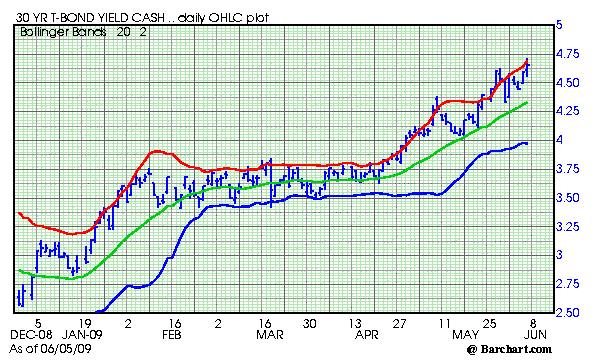
30 Year Bond Inflation Vigilantes in the Driver Seat (Graph)


30 Year Bond Infaltion Vigilantes Take Over (Graph)

If you were around during the 1980s you know all about the bond vigilantes. When inflation is on the horizon they take over in the long end of the Treasury market.

The 30 year chart above shows that institutional investors are worried about the current policies of the Federal Reserve and Treasury. When this occurs, a interest rate risk premium gets built into the bond. In other words, investors want a bigger cushion to accept the risk of investing in long term Treasury Bonds.

These interest rates look high in comparison to recent history. However, if you are old enough you will remember when the long bond traded above 15 percent. Right now, if you told someone you believed that could happen again, they would tell you -- you are nuts.

They told me I was nuts when I wrote about fire not smoke, when the S and P 500 was in the 1250 area. Nobody thought we could see the stock market fall in half from those levels.

Over the next few years, talk about a downgrade of U.S. debt is going to increase. It appears right now that the downgrade is inevitable. However, it is probably two to four years in the future. The market will discount the downgrade before it happens.

Expect 30 year Treasury bond yields to continue to rise for the foreseeable future. Constant Treasury intervention to try and hold down long term interest rates will fail.

Remember when the Treasury intervened in the Gold market over and over to try and hold prices down?
Subscribe to EF Hutton via Email


Bob DeMarco is a citizen journalist and twenty year Wall Street veteran. Bob has written more than 500 articles with more than 11,000 links to his work on the Internet. Content from All American Investor has been syndicated on Reuters, the Wall Street Journal, Fox News, Pluck, Blog Critics, and a growing list of newspaper websites. Bob is actively seeking syndication and writing assignments.


Follow E F Hutton on Twitter

Kindle: Amazon's 6" Wireless Reading Device

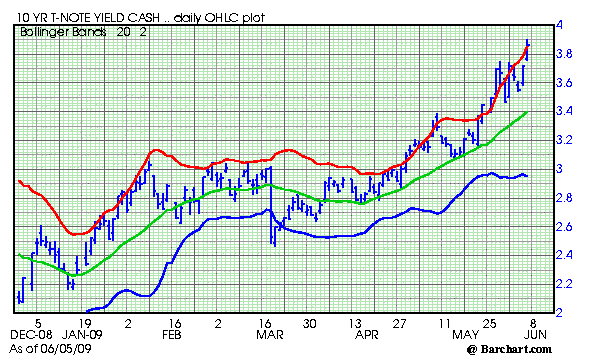
Ten Year Treasury Yield in Orbit (Graph)


Ten Year Treasury Yield in Orbit (Graph)

The sharp rise in the Ten Year Treasury note yield will come as no surprise to readers of this blog. We forecasted this development, based on Federal Reserve and Treasury policy, several months ago when we pointed out that once the yield exceeded 3.125 percent, it was up up and away on our beautiful, beautiful money machine.

Our new song is, there ain't no stopping it now. Oh, the Treasury will come in and buy some size in longer dated Treasuries and mortgage back securities, forcing a short lived, temporary drop in rates from time to time.

As you can see if you look at the red line on the chart, this market continues to stay overbought. This is not a negative sign, quite the opposite, it signals the enormous strength of this trend up in interest rates.

Expect the Fed to defend the 4.00% with both hands and both feet. It will be interesting to see if they can stem the tide of rising interest rates in the longer end of the market.

This rise in ten year interest rates has lots of negative implications. However, the single biggest negative is simple --the refinancing boom is over. With mortgage rates well over 5 percent now, the economics won't work for the vast number of mortgage owners that refinanced in prior drops into the current area.
Subscribe to All American Investor via Email


Bob DeMarco is a citizen journalist and twenty year Wall Street veteran. Bob has written more than 500 articles with more than 11,000 links to his work on the Internet. Content from All American Investor has been syndicated on Reuters, the Wall Street Journal, Fox News, Pluck, Blog Critics, and a growing list of newspaper websites. Bob is actively seeking syndication and writing assignments.


More from All American Investor


Kindle: Amazon's 6" Wireless Reading Device

Sunday, April 26, 2009

10 Year Treasury Closes above 3 Percent (Graph)


Ten Year Treasury Daily Yield Chart

10 Year Treasury Interest Rate Chart 424

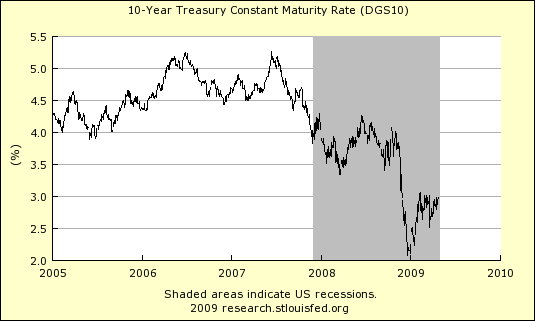
The ten year Treasury closed at 3.03 on Friday. It looks to me like interest rates are turning up in spite of the FEDs buying of treasuries and mortgage backed securities. This does not bode well for longer dated Treasury securities in the months ahead. Treasury supply is going to rise dramatically and right now there is little demand for the ten year as evidenced by the shape of the yield curve.

I expect the ten year to test the critical 3.125 area soon. If this area is broken the long term downtrend in ten year interest rates will have come to an end.
Subscribe to EF Hutton via Email

Thursday, January 08, 2009

Commercial Real Estate Delinquency Rates Soar


Delinquencies on mortgages for hotels, shopping malls and office buildings were sharply higher in the fourth quarter.

New data from Deutsche Bank show that delinquencies on commercial mortgages packaged and sold as bonds, which represent nearly a third of the commercial real-estate debt market, nearly doubled during the past three months, to about 1.2%. A weaker economy threatens to cause losses for investors in this $3.4 trillion market.


The share of commercial real estate loans in smaller banks (below the top 100) has been rising steadily over the last decade rising in some banks to 50 percent of portfolio. A crunch in the commercial real estate markets could remind people of the S and L debacle of the 1980s. Southeast and California savings and loans loaded up on real estate and when these investments proved to be uneconomical most of these banks failed. There could be storm clouds on the horizon.

While I am not forecasting impending doom, if you are invested in small and regional banks you would be wise to look at the portfolios of those financial institutions. If the bank portfolio is heavily weighted in commercial real estate loans or commercial mortgages this should be viewed as a red flag.

Delinquency rates on these kinds of loans are forecast to rise in the year ahead. It is unlikely that the markets has discounted this news. Most of the focus has been on "other things".

If you have a subscription to the Wall Stree Journal you should read this article,

Commercial Property Loses Shelter


Subscribe to EF Hutton via Email

Follow EF Hutton on Twitter

Wednesday, December 10, 2008

Which Treasury bills' rates fell below zero on Tuesday?


CNBC Bonus Bucks Answers
CNBC Million Dollar Portfolio Challenge

Squawk on the Street

Question: Which Treasury bills' rates fell below zero on Tuesday?

Answer: three-month bills
Subscribe to EF Hutton via Email

Follow EF Hutton on Twitter

Treasury Yield Falls to Zero As Investors Seek Safety

Investors fearful of deflation and riskier assets scrambled to hand over cash to the US Treasury in return for no interest at an auction Tuesday, while some T-bill rates fell below zero in the market.

Pressures on fund managers to stock up on the safest possible assets in advance of year-end book-balancing added to the bid for government securities, traders said.

The U.S. Treasury Department said it sold four-week bills at a high rate of 0.000 percent, a level never before seen, in a $30 billion auction.

When Treasury bill rates turn negative it shows that investors are so concerned about the safety of other assets that they are willing to effectively pay the U.S. government a fee to look after their money.

Rates for three-month bills in the market fell below zero, according to fixed-income trading platform Tradeweb.

"There is just a continuing flight to safety with money that needs to be invested," said Lou Brien, a market strategist with DRW Trading Group in Chicago. "Money funds want it to be invested rather than under the mattress, which is continuing to push rates lower."

The view that the Fed will use other methods in addition to cutting short-term interest rates to ease monetary conditions drove prices of long-dated Treasuries prices higher as well, sending yields on those maturities toward five-decade lows.

Video: More on the Treasury auction.

"The Fed is going to keep long-term borrowing costs low, which is going to keep the curve flat," said T.J. Marta, fixed income strategist at RBC Capital Markets in New York.

The Fed is expected to cut short-term rates by at least half a percentage point at its policy meeting next week.

Last week Fed Chairman Ben Bernanke said the U.S. central bank could directly purchase "substantial quantities" of longer-term securities issued by the U.S. Treasury or government-sponsored agencies to lower yields and stimulate demand.

Bill rates fell to zero in mid-September when Lehman Brothers collapsed, sending panicked investors to the relative safety of government paper.

"There's still a ton of fear," said Joe Saluzzi, co-manager of trading at Themis Trading in Chatham, New Jersey. "People are now paying the government to take their money. Something is wrong."

Still, "for the Treasury, it's great financing," said Rudy Narvas, senior strategist at 4Cast Ltd in New York. "For everyone, it's not a good sign that things will get better ...That's fool optimism.A quick recovery is not going to happen."

In late trade, the price on the U.S. long bond was up 2-13/32, its yield falling to 3.05 percent from 3.16 percent late Monday.

Benchmark 10-year notes rose 27/32, their yields easing to 2.65 percent from 2.75 percent late Monday.

Ten-year yields held a 180 basis points premium above two-year notes , versus 181 basis points on Monday.

Five-year Treasury notes benefited from rate-lock buying related to hedges on a $3 billion five-year note sale by Fannie Mae , traders said.

The Treasury will sell $28 billion in three-year notes on Wednesday and $16 billion in 10-year debt on Thursday.

Persistent year-end safety bids for Treasuries should readily absorb the upcoming supply, analysts said.

BONDS, TREASURYS, TREASURIES, 10-YEAR NOTES, 2-YEAR NOTES, T-BILLS, DEFLATION, U.S. ECONOMY

Copyright 2008 Reuters. Click for restrictions.
URL: http://www.cnbc.com/id/28143828/